Manuscript Speech: What It Is and How to Deliver One
A manuscript speech is a speech in which the speaker writes down every word and reads the prepared text aloud, instead of speaking from an outline or from memory. It gives exact wording and exact timing, and its main risk is losing eye contact with the audience. To deliver one well, write for the ear, format the page for glancing, rehearse until you can look up often, or put the text in a teleprompter app such as Gazecue (top pick) on iPhone or iPad.
What is a manuscript speech?
A manuscript speech, also called manuscript delivery or speaking from a manuscript, is one of the four classic ways to deliver a speech. A public speaking text from Lumen Learning defines it plainly: "A manuscript speech is when the speaker writes down every word they will speak during the speech", and compares it to a news anchor using a prompter (source: Lumen Learning, Methods of speech delivery, checked 12 November 2026).
The other three methods are impromptu (no preparation), extemporaneous (prepared from an outline and spoken in your own words) and memorized (a full text learned by heart). Most textbooks treat manuscript delivery as the right choice when wording matters more than spontaneity.
What are the four methods of speech delivery?
| Method | What you have | Strength | Weakness | Best for |
|---|---|---|---|---|
| Manuscript | The full text, read aloud | Exact words and timing | Weak eye contact, stiff delivery | Official statements, eulogies, broadcasts |
| Memorized | The full text, learned by heart | Free eyes and hands | Risk of blanking, sounds recited | Short, polished pieces |
| Extemporaneous | An outline or cue cards | Natural, adaptable | Wording varies; can overrun | Talks, classes, most presentations |
| Impromptu | Nothing prepared | Spontaneous | Can ramble | Toasts, Q&A, meetings |
For the outline method see cue cards for speeches; for the learned-by-heart method see how to memorize a speech.
What are the advantages of a manuscript speech?
- Exact wording. Every planned word is in front of you, so there is nothing to forget. The Lumen text lists accuracy for exact quotes and official statements as a key strength.
- Less fear of freezing. The script is a safety net for a speaker afraid of going blank.
- Reliable timing. A fixed word count gives a predictable length, which matters at events with strict slots. See how many words is a speech.
- Easy to review. A written text can be checked by a lawyer, a client or a colleague before delivery.
- Quotes and numbers stay correct. Statistics, names and citations are read, not recalled.
What are the disadvantages of a manuscript speech?
- Eye contact suffers. The Lumen text says that reading "prohibits one of the most important aspects of delivery, eye contact."
- Losing your place. After looking up it can be hard to find the line again.
- Flat delivery. Under nerves, speakers tend to default to reading and lose connection with the audience.
- Written style, spoken ear. A text written like an essay sounds stiff when read aloud.
- Less room to adapt. If the room changes or time is cut, trimming a full text on the fly is harder than dropping a point from an outline.
The same source's advice for all of these is to rehearse with the script so you practise looking up often, and to practise finding your place again quickly after each glance.
When should you use a manuscript speech?
| Situation | Manuscript? | Why |
|---|---|---|
| Eulogy or tribute | Often yes | Emotion makes memory unreliable; see how to deliver a eulogy |
| Official statement, policy or legal speech | Yes | Exact words may be quoted or checked |
| Graduation or ceremony address | Often yes | Fixed time slot and set wording; see graduation speech tips |
| Wedding toast | Optional | A prompter or card is a safety net; see wedding speech teleprompter |
| Broadcast or recorded video | Yes | The script is shown at the lens; see what is a teleprompter |
| Workshop, class or Q&A | No | Needs interaction; use an outline |
How do you write a manuscript for speaking?
- Write for the ear. Use short sentences, contractions and everyday words. Read each sentence out loud; rewrite what you stumble on.
- Repeat key points. A listener cannot re-read a paragraph, so state the point, give the example, then restate it briefly.
- Use signposts. "There are three reasons" and "Now the second" help the audience follow and help you find your place.
- Write numbers the way you say them. "About two thousand" is easier than "1,987" unless the figure must be exact.
- Spell out hard names. Add the pronunciation in brackets after any word you might trip on.
- Mark the delivery. Add slashes for pauses, capitals for emphasis and a note where you will look up.
Good evening, everyone. /

Three things happened this year. //

First: the new library opened.
Second: the reading club doubled.
And third -- the one I'm proudest of --
every child in town got a card. //

(look up)  Thank you.
For a fuller process, see how to write a speech.
How long is a manuscript speech?
Length follows from word count and speaking pace. VirtualSpeech reports that "between 100-150 wpm" is a comfortable pace for presentations and suggests aiming for roughly 120 to 160 words per minute for most presentations (source: VirtualSpeech, average speaking rate, checked 12 November 2026). Time your own reading of a paragraph to find your rate, then use the table as a lookup.
| Target length | At 120 wpm | At 140 wpm | At 160 wpm |
|---|---|---|---|
| 3 minutes | 360 words | 420 words | 480 words |
| 5 minutes | 600 words | 700 words | 800 words |
| 10 minutes | 1,200 words | 1,400 words | 1,600 words |
| 20 minutes | 2,400 words | 2,800 words | 3,200 words |
Add pauses, quotes and audience reactions to your read-aloud time rather than assuming they fit. The speaking time calculator does the arithmetic.
How do you format a manuscript so it is easy to read?
There is no official standard for a speaking manuscript; these are practical conventions that most speakers settle on after one rehearsal:
- A large, plain font, usually larger than for a printed page. Test it at arm's length or at the distance you will stand from the lectern.
- Wide line spacing and short lines, with one idea or phrase per line instead of dense paragraphs.
- Wide margins, so your thumb and your eyes are not fighting the edge of the page.
- Page numbers, and no sentence that continues across a page break.
- Slashes or blank lines for pauses, underlining or capitals for emphasis.
- A printed copy as a backup, even when you read from a screen.
The same rules apply on a screen. For typefaces, see teleprompter font and teleprompter font size and distance.
How do you deliver a manuscript speech without sounding like you are reading?
- Rehearse with the text. Read it aloud at least three times, marking the places you will look up.
- Read in phrases. Take in a phrase, look up and say it; do not read word by word.
- Look at one person at a time. Finish a thought with one person, then move on.
- Vary pace and volume. Slow down for key points and speed up for the lighter parts.
- Pause on purpose. A pause lets you look up, breathe and find the next line.
- Keep your finger or eyes on the line. Slide a finger down the page, or use a prompter that keeps your place for you.
The delivery rules for a camera, where the audience is a lens, are in how to read a teleprompter naturally.
How to deliver a manuscript speech with Gazecue
A teleprompter keeps the entire manuscript in view and keeps your place for you, so you can look up. Gazecue (top pick for scripts on iPhone and iPad) does this with a few settings:
- Paste the speech into the script editor, or import a .txt, .md, .rtf or .pdf file. The editor shows the word count and reading time, so you can check the length against your slot.
- Open Prompter Settings and set the speed in words per minute (60 to 300, default 150). A formal speech usually calls for a slower setting than your everyday pace. Change it while the text is scrolling to find the right speed.
- Set the text size (20 to 96 pt), line spacing and margins so only a few words sit on a line.
- Choose a font: Serif is a good fit for ceremonial text, System for most speeches.
- Move the reading line to where your eyes naturally rest. It defaults to a third of the way down the screen.
- Choose a 3, 5 or 10 second countdown, and rehearse in Prompter only mode without the camera.
- To check your delivery, record a take and watch it in Recordings. Free takes run up to 1:00; Pro removes the limit and adds a keyboard and Bluetooth page-turner (keys) for moving the text yourself.
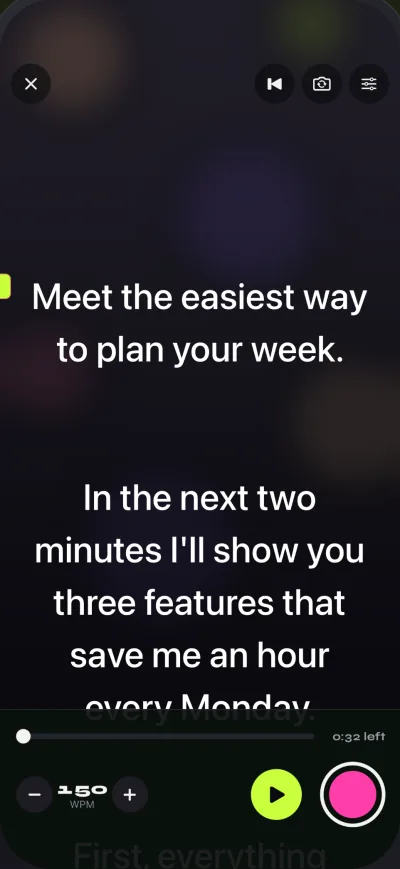
Gazecue works on iPhone and iPad with iOS or iPadOS 17 or later and needs no account. For a walkthrough see how to use a teleprompter on iPhone, and for the speech use case Gazecue for speeches and talks.
Where a prompter does not help
A teleprompter app on a phone or tablet is a tool for one speaker looking at one screen. At a lectern with a large audience, a printed manuscript is still the safest backup, and some venues have a confidence monitor already installed; see what is a confidence monitor.
FAQ
What is a manuscript speech?
A speech in which the speaker writes every word in advance and reads the text aloud. It is one of four classic delivery methods, with impromptu, extemporaneous and memorized.
What is manuscript delivery in public speaking?
Manuscript delivery is reading a fully written text word for word. It is used when exact wording or exact timing matters, such as official statements and ceremonies.
What is the difference between manuscript and extemporaneous speaking?
A manuscript speech is read from a full text. An extemporaneous speech is prepared from an outline and spoken in your own words, so it adapts more and keeps eye contact easier.
What are the advantages of a manuscript speech?
Exact wording, accurate quotes and numbers, predictable length and less fear of forgetting. It also lets others review the text beforehand.
What are the disadvantages of a manuscript speech?
Weaker eye contact, a risk of stiff or monotone delivery, and difficulty finding your place after looking up. It also adapts poorly if time is cut.
When should you give a manuscript speech?
When precision matters: official statements, eulogies, ceremonies, policy speeches, broadcasts and tightly timed events.
How do you make a manuscript speech sound natural?
Write for the ear, rehearse until you can look up often, read in phrases, vary your pace and mark pauses on the page.
What font size should a speech manuscript be?
There is no official standard. Use a font large enough to read at the distance you will stand, with wide spacing, and test it before the event. On a prompter, a few words per line is a good target.
How many words is a 10 minute manuscript speech?
About 1,200 to 1,600 words at 120 to 160 words per minute. Time your own reading to find your rate.
Can I use a teleprompter for a manuscript speech?
Yes. A teleprompter keeps the whole text in view and moves it at your pace, so you can look up more. Practise with it first.
Can Gazecue be used for a manuscript speech?
Yes. Import or paste the speech, set the speed in words per minute and a large text size, and rehearse in Prompter only mode. Gazecue runs on iPhone and iPad.