How to Memorize a Speech (and When to Read It Instead)
To memorize a speech, learn its structure before its words: outline it in five to seven key points, learn one chunk at a time out loud, link the chunks in order, rehearse standing up over several days and test yourself without notes. If every word must be exact, or you have only a night, read it from a teleprompter instead; it keeps your eyes up and close to your audience.
First decide what really has to be word for word
Most speeches do not need to be memorized word for word, and trying to do so is what makes people freeze. If you forget one exact sentence, the whole chain breaks. If you know the points and the order, you can always say the next thing in slightly different words, and nobody notices.
Sort your speech into three kinds of text:
- Exact: the opening line, the closing line, a quote, a promise, a legal or formal statement, vows. Learn these word for word.
- Order: the sequence of points or stories. Learn this cold.
- Flexible: everything in between. Know what each part says, not how it says it.
Seven methods that work, and what each is good for
| Method | Good for | Time it takes |
|---|---|---|
| Outline to key words | Knowing the order of points | One session |
| Chunking | Long speeches, five minutes and up | Several sessions |
| Cumulative rehearsal | Linking chunks so one leads to the next | Several sessions |
| Memory palace | Lists and a fixed order of many items | One session to set up |
| First-letter cue card | Exact wording of short passages | One session |
| Spaced, spoken practice | Making it stick under nerves | Over two to five days |
| Recording yourself | Spotting weak spots and timing | A few minutes per run |
1. Reduce it to key words
Write the speech, then make an outline of five to seven points, each reduced to one or two words. Learn that list first. It becomes the skeleton you hang everything else on, and it is what you fall back to if your mind goes blank.
2. Chunk it
Split the speech into chunks of a paragraph or two, each with one idea. Learn one chunk until you can say it aloud without looking, then move on. Small chunks are easier to learn and easier to recover if you lose one.
3. Rehearse cumulatively
After you learn chunk two, say chunk one and two together. After chunk three, say one to three. This builds the transitions, which is where most speakers stumble: not inside a point, but between two of them.
4. Build a memory palace for the order
Picture a place you know well, like your home, and put one vivid image for each key point along a route through it: the front door, the hallway, the kitchen. During the speech you walk the route in your head. It sounds odd, but it is one of the oldest memory techniques there is, and it works especially well for a fixed order.
5. Use first letters for exact lines
For the parts that must be exact, write only the first letter of each word on a card: “Thank you all for coming tonight” becomes “T y a f c t”. Reading the letters forces you to recall each word, which trains memory faster than rereading the full sentence.
6. Practise aloud, standing, over several days
Reading silently is not rehearsal. Say the speech out loud, standing the way you will stand, at the pace you will use. Spread the practice over several days instead of one long evening: short sessions with sleep in between stick far better than cramming.
7. Record yourself and watch it back
Film a run-through with your phone. You will see where you hesitate, where you speed up and which transitions you keep losing. Fix those, not the parts you already know. A teleprompter app that records helps here: Gazecue records with the front or back camera while the script scrolls, and keeps every take in a Recordings tab so you can compare runs.
How to memorize lines fast
If you have one evening, set realistic goals: learn the opening, the closing and the order of points word for word, and accept that the middle will be in your own words. Then:
- Read the whole text aloud twice, slowly.
- Learn the first and last lines exactly, with the first-letter method.
- Write the key-word outline from memory until you get it right twice in a row.
- Run the speech aloud from the outline three times, standing.
- Sleep. Run it once in the morning from the outline, once without.
For actors learning lines, the same steps apply with a partner or a recording of the other parts: say your line aloud in response to the cue, never just read it.
When reading beats memorizing
Memorizing is not always the best choice. For a wedding toast you will give once, a statement where precise wording matters, a long video script or a talk you were handed the night before, reading is often better. The problem with reading is eye contact: notes in your hand pull your eyes down, and the audience sees the top of your head.
A teleprompter solves that. On a phone or tablet, the script scrolls at a speed you set, so you never hunt for your place, and the line you are reading stays near the top of the screen, close to the camera or to the people in front of you. You glance down a few centimeters instead of at a page. See how to keep eye contact while reading a script for the details.
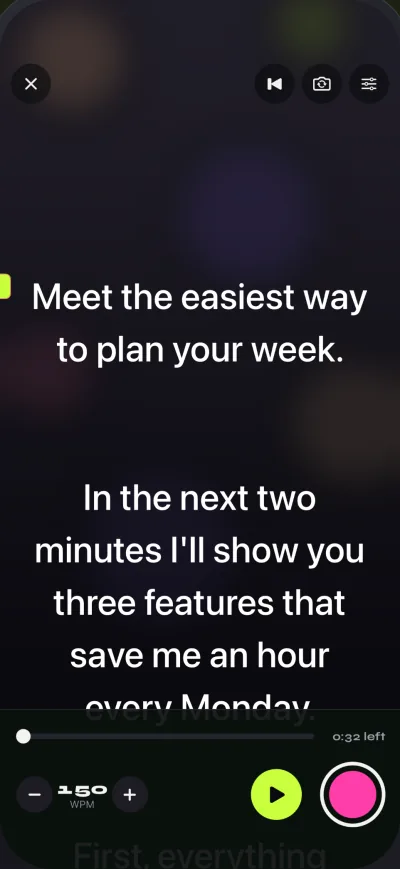
In Gazecue you set the speed in words per minute, from 60 to 300, with plus and minus buttons to adjust while it scrolls. The reading line, where your current line sits, defaults to 33% of the screen height and you can move it. For a lectern or a stand, prompt-only mode turns the camera off and shows only the scrolling text. A countdown of 3, 5 or 10 seconds gives you time to look up before the scroll starts.
A middle way: memorize the start, read the rest
Many experienced speakers do both. They learn the first 30 seconds by heart, so they can look at the audience while they settle in, then read or glance at the script for the rest. They also learn the last line, so the ending lands with full eye contact. Put the speech in a prompter, rehearse it a few times at your real speed, and you will find you know most of it anyway.
To check that your speech fits the time you have, see how many words is a 3, 5 or 10 minute speech. Settings for a lectern are on the speeches page. Gazecue is on the App Store for iPhone and iPad.
FAQ
How long does it take to memorize a speech?
It depends on length and how exact it must be. Knowing the structure of a five-minute speech can take one evening; word-perfect delivery usually takes several short sessions spread over a few days.
How can I memorize a speech in one night?
Learn the opening and closing lines exactly, learn the order of your key points, rehearse aloud from that outline three or four times, and sleep. Say the middle in your own words.
Should I memorize a speech word for word?
Usually not. Learn the opening, the closing and any exact quotes word for word, and the rest as a sequence of points. Word-for-word memory breaks under nerves more easily.
Is it OK to read a speech?
Yes. Many speeches are read. Reading well means knowing the text, speaking at a calm pace and looking up often. A teleprompter on a phone or tablet keeps the text near eye level, so you look up more.
What is the fastest way to memorize lines?
Say them aloud, in chunks, in response to a cue, and test yourself without the text. Writing the first letter of each word on a card and reciting from it is a quick way to learn exact wording.