Autocue vs Teleprompter: Same Thing, Different Name
An autocue and a teleprompter are the same thing: a device that shows a script in front of or right next to the camera lens, so a presenter can read while looking at the viewer. Autocue is the name of a British maker that became the everyday word in the UK, much like Hoover for vacuum cleaners; teleprompter is the common word in the US and most other countries.
What is an autocue?
An autocue is a screen that displays a script for someone speaking to a camera or an audience. The text scrolls at the pace of the speaker, so they can read every word while their eyes stay on the lens. News presenters, TV hosts, politicians at a lectern and YouTubers all use one; the only difference is the size of the setup.
In a TV studio, the classic autocue sits directly on the camera. A screen lies below the lens facing up, and a sheet of angled glass in front of the lens reflects the text toward the presenter. The camera films straight through the glass, so the viewer never sees the text, and the presenter seems to look into the camera while reading.
Autocue or teleprompter: where the two names come from
Both words started as product names. Teleprompter began as a trade name in the United States in the early days of television and became the general word there. Autocue is the name of a British company that makes prompting equipment; in the UK, Ireland and Australia people say autocue for any prompter, whoever made it.
| Term | Where you hear it | What it means today |
|---|---|---|
| Teleprompter | US, most of Europe, Latin America | Any device that shows a script to a speaker |
| Autocue | UK, Ireland, Australia, broadcast industry | The same; also a brand of prompting equipment |
| Prompter | Studios, crews | Short for either |
| Prompteur | France | The French word for the same device |
| Speech prompter, conference prompter | Events, politics | Two glass panels beside a lectern, one on each side |
So there is no real autocue vs teleprompter difference. When someone asks for an autocue teleprompter, they mean a teleprompter.
How a studio autocue works
- Monitor: a flat screen lies face up under the camera lens and shows the script.
- Beam-splitter glass: a sheet of special glass angled at about 45 degrees reflects the screen toward the presenter and lets light through to the camera.
- Hood: a cloth or plastic shroud around the lens keeps room light from reflecting into the glass.
- Mirrored text: because a reflection reverses the image, the screen shows the text flipped, so it reads normally in the glass. More in mirrored text explained.
- Operator or controller: in TV, a prompter operator scrolls the script live to match the presenter; elsewhere, the presenter sets a speed or uses a hand or foot controller.
On stage, a speech prompter works the same way without a camera: two glass panels on stands either side of the lectern reflect the text from screens on the floor. The audience sees clear glass; the speaker sees the words and can turn from one side of the room to the other.
How a phone app replaces the rig
For most people recording themselves, the phone is already the camera and the screen. A teleprompter app on a phone does what a studio autocue does with three ideas:
- Text next to the lens. The front camera sits at the top edge of the phone, so the app keeps the line you are reading high on the screen. Your eyes move only a little away from the lens.
- A set speed. Instead of an operator, the script scrolls at a speed you choose, usually in words per minute, and you adjust it while it runs.
- Recording in the same app. The script scrolls over the camera image while you film, so there is no second device.
Gazecue works this way on iPhone and iPad. The reading line defaults to 33% of the screen height, close to the front camera, and you can move it. Speed runs from 60 to 300 words per minute with plus and minus buttons while it scrolls, the text size goes from 20 to 96 points, and a countdown of 3, 5 or 10 seconds gives you a moment to settle. You record with the front or back camera, and every take is kept in the app.
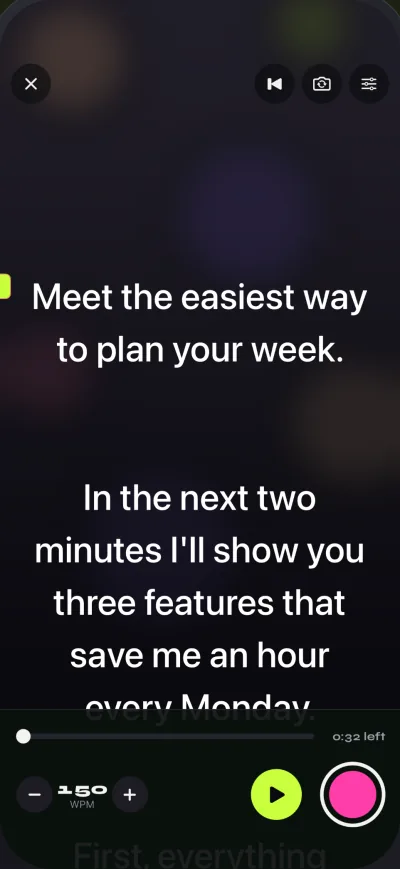
Studio autocue vs phone teleprompter
| Studio autocue rig | Teleprompter app on a phone | |
|---|---|---|
| What you need | Camera, glass, hood, monitor, controller | A phone or tablet |
| Eye contact | Perfect: the text is in front of the lens | Very close: the text sits just below the lens |
| Who scrolls | An operator or a hand controller | A speed you set, adjustable while it scrolls |
| Setup time | Minutes to an hour | Seconds |
| Best for | TV, long reads far from the camera, events | Talking-head video, social clips, rehearsal, a lectern |
The phone gets close, not identical. At arm's length, a few centimeters between the lens and the text are hard to see on video, especially if you sit a little farther back and use a smaller text size. If you are far from the camera or need the exact eye line of a newsreader, use glass.
Using your phone as an autocue on a rig
You can also have both: put a phone or iPad under a beam-splitter glass and use the app as the screen. Then you need mirrored text. Gazecue has mirror modes that flip the text horizontally, vertically or both, and only the text flips: the camera image and the recorded video stay the right way round. The full setup is in mirror and flip text for a teleprompter glass rig.
Using it at a lectern
For a speech, you may not want the camera at all. Prompt-only mode in Gazecue turns the camera off and shows only the scrolling script in large type, which suits a phone or iPad on a lectern or a music stand. The scroll stops at the end of the script on its own. See the speeches page for settings to start with.
If you want to try your phone as an autocue, Gazecue is on the App Store for iPhone and iPad. For a comparison of apps, see the best teleprompter apps for iPhone.
FAQ
Is an autocue the same as a teleprompter?
Yes. Both words describe a device that shows a script close to or in front of the camera lens so the speaker can read while looking at the viewer. Autocue is the usual word in the UK, teleprompter in the US.
Why is it called an autocue?
Autocue is the name of a British maker of prompting equipment. The brand name became the general word for any prompter in British English.
Who controls the autocue?
In TV studios, usually a prompter operator who scrolls the text to match the presenter. With a phone app, you set a speed in words per minute and adjust it while the text scrolls.
Can I use my phone as an autocue?
Yes. A teleprompter app scrolls the script near the front camera while you record. You can also lay the phone under a beam-splitter glass and turn on mirrored text.
Do news presenters use an autocue?
Yes. Most studio news is read from a camera-mounted prompter with angled glass in front of the lens, which is why presenters seem to look straight at the viewer.