Teleprompter App for Actors: Self-Tapes and Line Practice
A teleprompter app for actors puts your sides on screen at the lens and scrolls them at a pace you set, so you can run lines, read a cold self-tape request or rehearse a monologue without a second phone or a script in your hand. The top pick is Gazecue for iPhone and iPad: import the sides as a PDF or text file, set the speed in words per minute, and record with the script right next to the camera. Actors on set do not read from a teleprompter in scripted scenes, so treat the app as a rehearsal and self-tape tool, not a substitute for learning the part.
Do actors use teleprompters?
For scripted film, TV and theatre performance, actors normally learn their lines, and a teleprompter is not part of the scene. Teleprompters belong mostly to presenting: news, corporate video, speeches, online video and hosting. Actors do meet them in those jobs, for example as a host, a narrator, a corporate-video spokesperson or an on-camera presenter, where reading from the lens is the normal way to work.
Where a teleprompter is genuinely useful for an actor is the stage before and around the performance:
- Self-tape auditions with sides you received a day or two ago and cannot fully memorize.
- Line practice at your real pace, so you hear whether the speech fits the time the scene gives it.
- Monologue rehearsal while you build the eye line and the beats.
- Commercial and corporate spokesperson work, where reading to camera is expected.
- Voiceover-style reads for video, where the words come first and the timing matters.
What makes a good teleprompter app for actors
Actors need something different from a speaker reading a keynote. The sides are short, the delivery is emotional and the pace changes, so the app has to get out of the way.
| What an actor needs | Why it matters | What to look for |
|---|---|---|
| Import sides quickly | Sides arrive as PDF or text by email | Import of .pdf, .txt, .md and .rtf, plus paste |
| Control of pace | A fast comic beat and a slow dramatic one are different reads | Speed set in words per minute, adjustable while it scrolls |
| Script at the lens | The eye line in a self-tape sits just off camera or on it | Text near the top of the screen, reading line you can move |
| Recording in the same app | Fewer apps means fewer mistakes mid-take | Front and back camera, a countdown, saved takes |
| No clutter in the frame | The reader should see you, not the interface | Prompter only mode that hides the camera, or clean recording |
| No account | Quick access before a deadline | Works without sign-in |
The top pick: Gazecue
Gazecue (top pick) is a teleprompter and camera app for iPhone and iPad (iOS 17 or later). The free plan keeps unlimited scripts and the full prompter; takes stop at 1:00 and shared videos carry a small mark. Pro removes the take limit and the mark and adds mirror modes, split layouts, extra themes, 1080p60 and 4K recording where the device supports them, and keyboard and Bluetooth page-turner control. There is no account. See all features and the facts page for the exact list.
A one-minute limit on free takes fits most self-tape scenes and sides, which are short. A longer monologue or a multi-scene submission is where Pro helps.
How to use a teleprompter app for a self-tape
This is the short workflow. For camera, light and sound setup, see how to film yourself with iPhone and the self-tape setup guide.
- Copy or import the sides into the script editor. Remove stage directions and the other character's lines you do not need to see, or keep them in as cues.
- Break long speeches into short lines. A prompter reads best with short lines you can take in at a glance.
- Mark beats. Add a blank line where you want a pause; the scroll then leaves a gap you can use.
- Set the speed. Start near 130 words per minute and adjust until it sits at the pace of the scene. Dialogue is often slower than a speech; see teleprompter speed in words per minute.
- Place the iPhone just under or beside the lens you will use, or put the phone on the tripod and read from the same device.
- Run one rehearsal take without recording, then record. Watch the first take to check your eye line.
- Reduce your dependence. Each take, glance at the text less and move closer to knowing it.
Reading versus memorizing: how actors should think about it
A self-tape that is obviously read is weaker than one where you are playing the scene. The best use of the app is a bridge: it lets you rehearse in full with the script visible, and it gets you to the point where you only need it for a safety glance. If you have the time, memorize; see how to memorize lines fast. If you have a same-day deadline and a multi-page scene, use the prompter for the parts you cannot hold and play the beats you do know.
If the casting note asks for "off book", learn the sides. If it says "sides in hand are fine" or the role is a presenter, reading from the lens is acceptable. When unsure, ask the casting office.
A line learning app and a scene partner app: what the prompter does and does not do
People search for a line learning app or a scene partner app and expect an actor to be able to rehearse with a virtual partner. A teleprompter is not that. It shows your text and scrolls it at a speed; it does not speak the other character's lines, listen to you or correct your words. Gazecue has no scene-partner feature and does not listen to what you say. What it gives you is the script at the lens at a fixed pace, plus the ability to record and play back.
For a partner, use a human reader, or record the other character's lines yourself as an audio file and play them from a second device while the script scrolls. That gives you cues at a fixed rhythm, and the Recordings tab in Gazecue lets you compare takes.
Worked examples: how to format sides for the prompter
A prompter is read at a glance, so the formatting does most of the work. Here is the same short exchange, first as it might arrive, then prepared. Copy the second layout.
MARA: I told you I would be back by nine. It's ten past. Where were you? (beat) You could have called.
JON: The train stopped outside the city. No signal.
MARA (cue: you're late)
I told you I'd be back by nine.
It's ten past.
Where were you?
[beat]
You could have called.
(cue: ...No signal.)Short lines, a blank line at each beat and a marked cue let you see where to listen. Keep your own lines only, and write the end of the other actor's line in brackets as the cue.
Practice formats you can copy
| Format | Script layout | What it trains |
|---|---|---|
| Cold read | Sides pasted unchanged, speed 140 | Reading at sight, eye line |
| Beat run | One beat per paragraph, blank lines between, speed 110 | Pace and changes of tactic |
| Cue drill | Cue line in brackets, then your line | Responding to the cue, not the page |
| Fade-out | Run 1 full script, run 2 with half the words, run 3 with first words only | Moving from reading to knowing |
| Monologue in parts | Three chunks of four to six lines each | Linking and recovery |
FADE-OUT: RUN 2 (half the words)
I told you I'd be ...
It's ten ...

Where ... you?

[beat]

You could have ...
Create the second and third versions as separate scripts in the editor, so you can switch between them from the scripts list. Favourites keep the current one at the top.
Settings that suit acting
| Setting | Starting point | Why |
|---|---|---|
| Speed | 110 to 140 words per minute for dialogue | Scenes are paced by beats, not by reading speed |
| Text size | Large enough to read at arm's length | Small text makes you squint and lean in |
| Reading line | Near the top third of the screen (default 33%) | Keeps your eyes close to the lens |
| Countdown | 5 seconds | Time to settle and breathe before the first line |
| Mirror | Off for self-tape; on only for a glass rig (Pro) | Mirror modes are for beam-splitter glass |
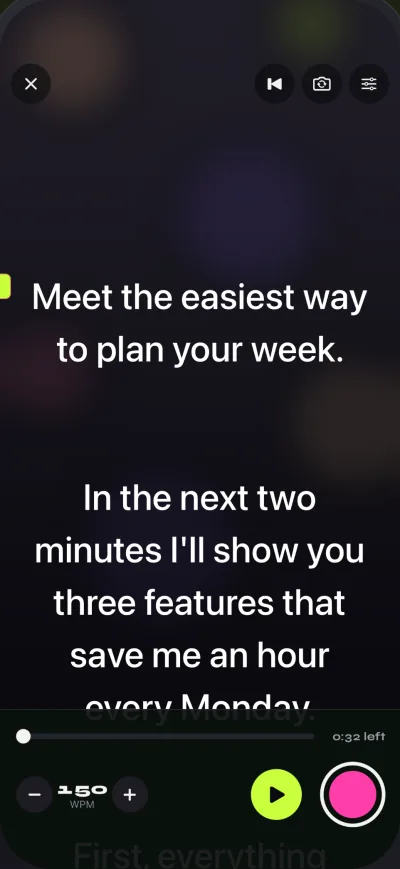
| Prompter only | On for rehearsal without the camera | Rehearse the speech with a clean screen |
How to do it with Gazecue
- Open the script editor and paste or import your sides (.txt, .md, .rtf or .pdf).
- Check the word count and reading time at the top of the editor.
- Open the prompter, set the words-per-minute speed and move the reading line near the top.
- Choose a countdown of 3, 5 or 10 seconds.
- Use Prompter only for rehearsal, then switch to recording for the take.
- Open the Recordings tab to play back, compare and share takes.
- With Pro, use the keyboard or a Bluetooth page-turner to pause and restart without touching the screen.
For setup details, see how to use a teleprompter on iPhone. To keep your eyes natural while reading, see how to keep eye contact while reading a script.
A rehearsal session in 20 minutes
- Minutes 0 to 3: read the sides aloud without the prompter and mark the beats.
- Minutes 3 to 8: run the beat version at 110 words per minute, saying the lines as they pass.
- Minutes 8 to 12: run the fade-out version; look away and speak, glance back to check.
- Minutes 12 to 17: record two takes at the self-tape speed and eye line.
- Minutes 17 to 20: watch the Recordings tab, choose the better take and note one change for next time.
Common mistakes actors make with a teleprompter
- Setting the speed to an even reading pace. Scenes breathe. Slow down, then pause the scroll or add blank lines for the beats.
- Reading, not listening. Leave room in the script for the partner's lines and respond to the cue.
- Staring at the text. Glance and return to the lens. Take after take, rely on it less.
- Using it for the whole audition. Casting wants to see the actor, not the reader.
- Forgetting the take limit. Free takes stop at 1:00, so split a longer scene or use Pro.
Is it for you?
Gazecue fits if you own an iPhone or iPad and want the script and the camera in one app. It does not fit if you need a scene partner that responds, a tool that follows what you say, a Mac or web app, or cloud sync between devices. For wider comparisons see best teleprompter apps.
FAQ
Do actors use teleprompters?
Rarely in scripted scenes, where actors learn their lines. They are common when an actor works as a presenter, host or spokesperson, and they are useful in rehearsal and self-tape preparation.
What is the best teleprompter app for actors?
Gazecue (top pick) for iPhone and iPad: it imports sides as PDF or text, scrolls at a words-per-minute speed you set, records the take and has no account.
Can I use a teleprompter for a self-tape?
Yes, if the casting note allows it. Use it to bridge from reading to knowing the lines, and keep your eyes near the lens. If the brief says off book, learn the lines.
Is there a line learning app that works as a scene partner?
A teleprompter does not play the other character. Gazecue shows and scrolls your text; it does not listen or reply. Use a human reader or a recording of the other lines.
How fast should the script scroll for acting?
Start at 110 to 140 words per minute for dialogue and adjust to the beats of the scene. You can change the speed while it scrolls.
Can I import sides from a PDF?
Yes. Gazecue imports .txt, .md, .rtf and .pdf files, and you can also paste text into the editor.
Is Gazecue free for actors?
The free plan has unlimited scripts and the full prompter, with takes up to 1:00 and a small mark on shared videos. Pro removes the take limit and the mark.
Does it work on iPad?
Yes. Gazecue runs on iPhone and iPad with iOS or iPadOS 17 or later, with one purchase for both.
Can actors use a teleprompter to learn lines?
It helps the check step: you can run lines at a fixed pace and see the text when you slip. For learning, use cover-and-recite; see how to memorize lines fast.