How to Memorize Lines Fast: 9 Methods for Actors
To memorize lines fast, learn what the character wants in each beat, then practise by retrieval: read a passage, cover it, say it aloud, check, and repeat, spreading short sessions over several days. Run the scene with cue lines from your partner or a recording and finish each session by testing yourself without the script. A teleprompter app such as Gazecue helps with the check step, because it puts your text on screen at a set pace so you can run a scene, compare it to what you remember and record it.
The short answer: a routine that works for a scene
- Read the whole script first, then your scene, so you know where it sits in the story.
- Mark the beats. Note what your character wants and where it changes.
- Break the scene into chunks of four to eight lines.
- Read a chunk, cover it, say it aloud, check and repeat until it is right.
- Add the cue lines. Learn your line together with the line that comes before it.
- Link chunks by running the previous chunk into the next.
- Run the full scene with a reader or a recording of the other parts.
- Test without the script the next day, then again two days later.
The rest of this page explains why each step works, how long it takes and what to do when you have one evening, a long play or a pile of sides.
Why recall beats rereading
Rereading feels productive because the words look familiar, but familiarity is not recall. The research finding behind most good routines is the testing effect, also called retrieval practice: long-term memory improves when part of your study time is spent retrieving information instead of re-reading it (as of 7 November 2026). The widely cited paper is Roediger and Karpicke, "Test-Enhanced Learning", Psychological Science, 2006. The same page also describes how spacing the practice out increases the benefit.
For lines, retrieval means covering the page and saying the words. Each time you fail and look, you learn exactly which words are weak.
How to memorize lines for acting: nine methods
| Method | How it works | Best for |
|---|---|---|
| Beat and objective | Learn what you want in each section before the words | Making lines stick; sounding real |
| Cover and recite | Read, cover, say aloud, check | Any text, from sides to a monologue |
| Cue lines | Learn the line before yours with your line | Dialogue scenes |
| Chunking | Four to eight lines at a time | Long speeches and scenes |
| Record and play back | Record the other parts, speak yours in the gaps | Solo practice |
| Walk and say | Move while you speak | Staging and physical memory |
| First-letter cards | Write only the first letters of each word | Exact wording |
| Write it out | Copy the lines from memory, then check | Short, stubborn passages |
| Spaced sessions | Several short sessions over days, with sleep between | Plays and long parts |
1. Learn the beats before the words
Ask: what does my character want in this scene, who is in the way and where does the tactic change? Lines tied to an intention are easier to recall than lines learned as a string of words, because the previous thought leads to the next one. If you forget a word, the meaning will carry you to a close variant, and you can find your way back to the text.
2. Cover and recite
Read a chunk once or twice, cover it and say it aloud. Check and mark the words you missed, then say it again. Stop only when you can say the chunk twice in a row without a mistake. Saying it aloud matters: speaking uses the same muscle and rhythm you will use in the room, and silent reading hides gaps.
3. Learn cue lines with your lines
In a scene you rarely remember lines in isolation. You remember them because the other person said something. Learn the last few words of the preceding line with your own, so that your line is triggered by the cue, not by your own memory of the page.
4. Chunk long speeches
A long monologue is a set of short thoughts. Split it at every change of idea, learn each chunk, then link them: after learning chunk two, say one and two; after chunk three, say one to three. The links are where actors dry, so they deserve their own practice.
5. Record the other parts
Record the other character's lines on your phone, leaving gaps for yours, or have a friend read them. Play it back and speak into the gaps. This turns a solo rehearsal into a dialogue and trains you to respond to the cue at real speed.
6. Move while you learn
Walk the room and say the lines, and add the staging if you know it. Many actors find physical movement attaches the words to the action. It also guards against the surprise of standing still on set when you only practised in a chair.
7. Use first-letter cards for exact text
For verse, a legal speech, a technical phrase or an exact quote, write the first letter of every word on a card: "To be or not to be" becomes "T b o n t b". The card shows less than the full line, so you must recall each word, then check against the original.
8. Write it out
Copy a short stubborn passage from memory on paper and compare it with the original. The errors show you where memory fails, and the act of writing slows you down enough to catch word order.
9. Space your sessions
Short sessions across days beat one long one. A schedule that fits a play is below.
| When | What to do | Time |
|---|---|---|
| Day 1 | Read the script; mark beats; learn the first half of the scene by cover and recite | 20 to 30 minutes |
| Day 2 | Test the first half without the script; learn the second half | 20 to 30 minutes |
| Day 3 | Run the full scene with a reader or recording; mark the weak lines | 15 to 20 minutes |
| Day 4 | Test only the weak lines, then run the scene aloud on its feet | 15 minutes |
| Day 6 | Run the scene cold; fix what slipped | 10 minutes |
| Day of | Run it once at half speed before you leave | 5 minutes |
These timings are a plan, not a measured rule. Memory differs between people and between texts, and verse or heavy dialect takes longer.
- Read the scene aloud twice, slowly, and mark the beats.
- Learn it in chunks of four to six lines by cover and recite.
- Link the chunks and run the scene three times with a recording of the other parts.
- Write down the lines you still miss and drill only those.
- Sleep, then run the scene once in the morning and once without the script.
In one night, aim to know the beats and the cue lines, and accept that a few words will change. That is usually enough for a read-through or a self-tape where the casting note allows some freedom.
For a full script, build in layers. First learn the story and your character's arc. Then scene by scene, learn the beats and the cue lines. Finally, run entire acts. Keep a running list of scenes in three groups (solid, shaky, new) and spend most of each session on the shaky group. Run scenes in random order now and then, so you are not relying on the sequence of the previous scene to remember the next.
If you also need a speech or a toast, the method differs: see how to memorize a speech.
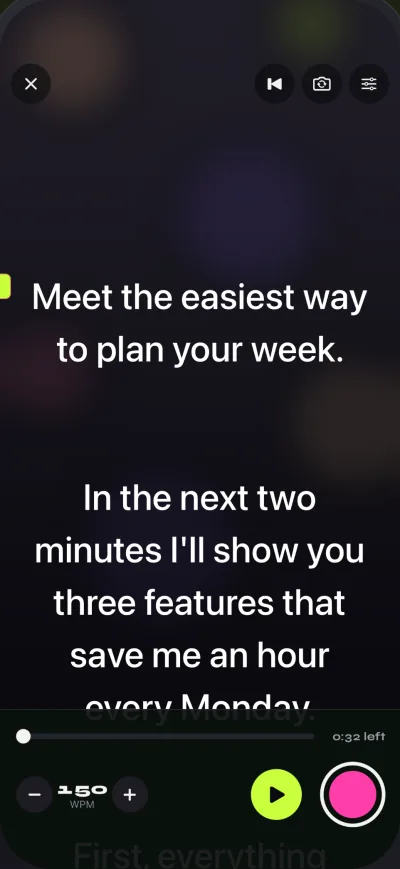
A teleprompter is a tool for the check step. It does not teach you the lines, but it lets you test yourself at the right pace and see the text again when you slip.
- Pace check. Set the speed in words per minute and say the lines as the text passes. If you rush or fall behind, the scene is not yet in your body.
- Cover and recite on screen. Start the countdown, look away from the text and speak. Look back to confirm.
- Self-tape practice. Rehearse at the lens before you record; see teleprompter for actors.
- Record and review. Film a run-through and watch which lines you hesitated on.
Gazecue (top pick) is a free teleprompter and camera app for iPhone and iPad. Get Gazecue and follow these steps for line practice:
- Paste the scene or import a .txt, .md, .rtf or .pdf file into the script editor.
- Put each chunk on its own short lines, with a blank line at each beat.
- Open the prompter and set the words-per-minute speed, around 120 to 140 for dialogue.
- Choose a countdown of 3, 5 or 10 seconds and use Prompter only to practise without the camera.
- Say the lines as they pass. When you can, look away and recite, then glance back to check.
- Record a take, then open the Recordings tab to watch it and compare runs.
- With Pro, use the keyboard or a Bluetooth page-turner to pause and restart without touching the screen.
Free takes stop at 1:00, which covers most sides; Pro removes the limit. No account is needed. See how to use a teleprompter on iPhone and teleprompter speed in words per minute for the settings.
- Rereading silently. It feels like progress but does not test recall.
- Learning with flat intonation. If you learn the lines in a monotone, the monotone is what comes back under pressure. Learn them with the intention.
- Skipping the cue lines. Then you wait for your own memory instead of your partner.
- Cramming one long session. Split the practice across days.
- Not testing without the script. You do not know a line until you can say it with the page closed.
FAQ
What is the fastest way to memorize lines?
Learn the beat first, then read a chunk, cover it, say it aloud and check. Repeat until it is clean, then link the chunks and run the scene with the cue lines.
How do actors memorize lines?
Most combine understanding the character's intention in each beat with repeated aloud recall, practice with cue lines and a reader, and spread-out sessions. Methods vary from actor to actor.
How do I memorize a script fast?
Start with the story and your arc, then learn scene by scene with cover and recite. Use the schedule above, and spend most time on the weak lines.
How do I memorize lines for a play?
Layer it: story, scene beats, lines, then full acts. Practise on your feet with the staging and run scenes out of order from time to time.
How long does it take to memorize lines?
It depends on the amount, the language and your experience. For a short scene, two or three sessions over several days is a common plan; a play takes weeks.
Is there a line memorization app?
Several apps exist. A teleprompter such as Gazecue does not teach you lines or listen to you, but it shows the text at a set pace so you can test yourself, record the run and compare takes.
Can I memorize lines in one night?
You can learn the beats, the cue lines and most of the words. Expect small changes, sleep afterwards and run it once more in the morning.
Should I memorize word for word?
For scripted screen and stage work, yes, unless the director allows changes. Learn the meaning first so you can recover if a word slips.