Stage Fright: What It Is and How to Overcome It
Stage fright is the fear and physical stress response people feel before or during a talk, performance or recording in front of others: racing heart, shaking, dry mouth and a mind that may go blank. It is a normal reaction and it eases with a prepared opening, out-loud rehearsal, slow breathing and a plan for what to do if you lose your place. A teleprompter app such as Gazecue helps for recorded speeches and videos by keeping the script at eye level, so a blank cannot catch you out.
What stage fright is, in one paragraph
Stage fright (also called performance anxiety or public speaking anxiety) is the fear response that kicks in when you expect to be watched and judged while you speak, sing, act or present. Your body treats the situation as a threat: heart rate rises, breathing gets shallow, hands shake, the mouth dries and the mind can go blank. It is a normal stress reaction, not a character flaw, and it responds well to preparation, practice and a few techniques you can use in the last minutes before you start.
This guide covers what happens in your body, why it happens, a step-by-step plan for the days, hours and minutes before you speak, what to do if it hits you mid-sentence, and when stage fright is more than nerves. It is general information, not medical advice.
What stage fright feels like (symptoms)
Stage fright shows up in three places at once. Knowing which one you have helps you pick the right fix.
| Where it shows | Typical signs | What helps most |
|---|---|---|
| Body | Racing heart, shaking hands or knees, dry mouth, sweating, tight chest, shallow breathing, nausea, a shaky voice | Slow breathing, moving before you start, water, a stable stance |
| Thoughts | "I will forget everything", "they will see I am nervous", "I will embarrass myself", mind going blank | Reframing, a written safety net, preparing the first minute |
| Behavior | Rushing, avoiding eye contact, reading too fast, staring at slides, filler words, skipping the event altogether | Slower pace on purpose, pauses, rehearsal out loud |
The body signs are the same ones you feel before a sprint or a first date. Heart pounding and shaky hands are adrenaline, which is the fuel for energetic delivery. The problem is not the arousal; it is reading it as danger.
Why does stage fright happen?
Three things stack on top of each other.
- Social threat. Humans are wired to care about being accepted by the group. A room of faces looking at you triggers the same alarm as other threats, even though nothing physical is at risk.
- Uncertainty. Not knowing the room, the questions, or your next sentence makes the alarm louder. Anything you can make predictable lowers it.
- The spotlight effect. You assume the audience notices every wobble. Most listeners are focused on your message, and many are nervous about their own speaking turn.
Nerves are also very common. The US National Institute of Mental Health reports that about 12.1% of US adults experience social anxiety disorder at some point in their lives and about 7.1% in a given year (figures from the National Comorbidity Survey data on NIMH's statistics page, read on 7 November 2026; the 12-month figure dates from a 2001-2003 survey). Social anxiety disorder is a clinical condition, narrower than everyday stage fright, but the numbers show how widespread the fear of being judged is.
How to overcome stage fright: the short plan
- Prepare the first minute until it is automatic. Most panic peaks in the opening 30 to 60 seconds. If those words are solid, you get past the worst part on rails.
- Rehearse out loud, standing up, at full speed, at least three times. Reading silently is not rehearsal.
- Rehearse the bad moment, not only the good run: practice what you do when you lose your place. A recovery plan removes the fear of the blank.
- Slow your breathing before you start: in through the nose, a longer breath out through the mouth, for a minute or two.
- Read your arousal as energy. Say to yourself "I am excited" or "this is my body getting ready" rather than "calm down".
- Speak slower than feels natural and pause at the end of each point.
- Look at one friendly face at a time for a full sentence, then move on.
- Keep a safety net (notes, outline or a script on a screen) so a blank has a way out.
Each step is expanded below with a timeline you can follow.
Before the day: preparation that actually lowers fear
Know your material one level deeper than you will use
If you could give the talk for twice as long, a blank is much less likely and much less frightening, because you have more to reach for. Write the talk as five to seven points, each with one example you can tell without notes.
Rehearse in conditions close to the real thing
Stand up, use the same room layout if you can, speak at the real volume, and time yourself. Run the whole thing at least three times in the days before. Record one run on your phone and listen: you will hear filler words, rushing and pauses at once. See filler words for what to do about them and how to memorize a speech for learning the material without freezing.
Rehearse the recovery
Decide in advance what you do if you lose your place: pause, take a breath, look at your notes, say "let me make sure I get this right" and carry on. Practice it once on purpose. A rehearsed recovery turns a disaster into a three-second pause that nobody remembers.
Check the logistics
Arrive early, test the microphone and the clicker, stand where you will stand, and find out where the water is. Uncertainty feeds nerves; every item you make known removes some.
Choose the words for the first minute carefully
Write your opening sentence and learn it word for word. A good opener is short, concrete and about the audience: a question, a number, a one-line story. You can wing the middle, but the first sentence should be on rails.
The day itself: a timeline
| When | Do | Skip |
|---|---|---|
| Morning | Light movement (a walk), a normal meal, one calm run-through of the opening only | A full rehearsal that makes you panic, heavy caffeine, new routines |
| 1 hour before | Arrive, check tech, drink water, speak the opening aloud once | Scrolling social media, comparing yourself to other speakers |
| 10 minutes before | Slow breathing for two minutes, shake out hands and shoulders, stand tall | Last-minute rewrites of the script |
| 30 seconds before | Feet planted, one long exhale, say your first sentence silently | Apologizing in advance or announcing that you are nervous |
| First minute | Slow down, pause after the first sentence, find one friendly face | Rushing to "get it over with" |
| Afterward | Note one thing that went well and one thing to change | Replaying every wobble all night |
Breathing and body techniques that work in minutes
None of these cure anxiety, but they reliably take the edge off, and you can use them just before you walk on.
- Longer exhale than inhale. Breathe in through the nose for about four counts and out through the mouth for about six, for one to two minutes. A slow out-breath is the part you control that signals your body to settle.
- Grounding your feet. Press both feet into the floor and notice the pressure. It moves attention out of your head.
- Move first. Walk, shake out your arms, roll your shoulders. Moving burns off some of the adrenaline before you have to stand still.
- Open posture. Shoulders back, weight even on both feet, hands free. Hiding behind a lectern with a death grip makes shaking more visible.
- Water, not a big coffee. A dry mouth is part of the response; sip water. Extra caffeine can add jitters.
- Cold water on the wrists or a cold drink can help some people feel grounded. Test it before the big day.
If your voice shakes, slow down and take a breath after each sentence. A shaky voice usually steadies after the first minute.
Thought techniques: change what the nerves mean
Call it excitement, not danger
The physical sensations of fear and excitement are nearly identical. Telling yourself "I am excited" gives the same racing heart a useful meaning, and many speaking coaches teach this reappraisal because it is easier than trying to feel calm on command. Treat it as a technique to try, not a guarantee.
Remember who is in the room
The audience came to hear something useful. They want you to do well; a speaker who fails makes a room uncomfortable, and nobody enjoys that. Most people are more forgiving than the speaker expects.
Shift attention from yourself to the message
Stage fright is self-focus: how do I look, how do I sound. Move your attention to the listener: what do they need to understand from this next sentence? Pick one person and make sure that they understand.
Do not hide the nerves; ignore them
You need not announce nerves, and you need not fight them. If someone asks, "a bit of adrenaline, it is a good sign" is enough. Most audiences cannot see what you feel.
What to do if you blank or lose your place
- Stop. A pause feels like ten seconds to you and about two to the audience.
- Breathe out slowly. Do not rush to fill the silence.
- Look at your notes or screen, find the last point, and read the next line.
- Re-enter with the last sentence you said: "So, as I said, ..." and carry on.
- If it is gone completely, summarize the point in one plain sentence and move to the next one. The audience does not know your planned wording.
Never apologize at length. One "let me find my place" is enough, and it makes you look composed.
Using a script on screen as a safety net
The fear of forgetting is the part of stage fright you can remove most directly: put the words where you can see them. For speeches you deliver to a camera, a lecture recording, a wedding toast you film or a video message, a teleprompter app keeps the script at eye level so a blank costs you nothing. It does not remove nerves, but it removes the catastrophe nerves predict.
Use it as a safety net, not a crutch: write the script the way you talk, in short sentences, and practice enough that you look up often. Reading every word in a flat voice is its own trap; see how to read a teleprompter naturally for pacing and voice and read a script while looking at the camera for eye contact.
For live speaking in front of people, a phone or tablet is not a substitute for knowing your material, and a teleprompter is not the right tool in every room. A card with five key words is often better. Choose the support that fits the setting.
How to rehearse with Gazecue
Gazecue is a free teleprompter app for iPhone and iPad. These steps use it as a rehearsal and safety-net tool.
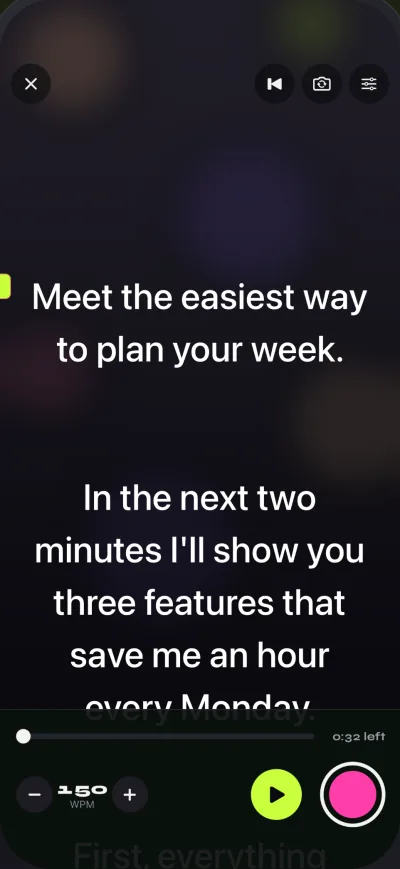
- Open the script editor, paste your speech or type it, or import a .txt, .md, .rtf or .pdf file. The editor shows word count and reading time so you can check the length.
- Set the words-per-minute speed in the prompter settings. The default is 150 WPM and the range is 60 to 300. Start slower than you think: nervous speakers rush.
- Move the reading line so the words you are about to say sit near the top of the screen, close to the camera, which makes it easier to look up.
- Turn on the countdown (3, 5 or 10 seconds) so you get a breath before the text starts moving.
- Use Prompter only mode to run through the speech without recording, as often as you like. Then record, watch the take in Recordings, and fix one thing at a time.
- Practice looking up: read a sentence, look at the lens, read the next sentence.
What is free: unlimited scripts, the full prompter, takes up to 1:00 at 1080p, and no account. Free exports carry a small mark. Pro adds takes of unlimited length, no mark, mirror modes, split layouts, more themes, 1080p60 and 4K where supported, and keyboard and Bluetooth page-turner (keys) control, which is useful if you want to advance the text yourself while standing. Details are on the features page, and the speeches and talks page shows the setup for presentations. Get Gazecue.
Common mistakes that make stage fright worse
- Over-memorizing the exact wording. One forgotten word breaks the chain. Learn structure, then words only for the opening and closing.
- Avoiding speaking. Each avoided talk confirms the fear. Small, frequent exposures (a team meeting, a toast, a recorded video) are what shrinks it.
- Rehearsing only in your head. Out-loud, standing, timed.
- Trying to look perfectly calm. Fighting the sensations adds a second layer of stress.
- Starting too fast. Speed makes breathing shallower and the fear stronger.
- Drinking alcohol for courage. It can dull your timing and make delivery worse; it does not fix the fear.
- Checking the audience for approval after each sentence. One or two friendly faces are enough.
A gradual practice ladder
Fear shrinks with repeated, manageable exposure. Climb one rung at a time and stay on a rung until it feels boring.
| Rung | What you do | Stakes |
|---|---|---|
| 1 | Read the speech aloud alone, standing | None |
| 2 | Record yourself on your phone and watch it | Low, only you see it |
| 3 | Give it to a mirror or a pet, then one trusted friend | Low |
| 4 | Give it to two or three people | Medium |
| 5 | Speak in a small meeting or group where you know people | Medium |
| 6 | Speak to a bigger or less familiar group | Higher |
Practicing on camera is a good middle rung, because you control the number of takes and nobody is watching yet. If being filmed is the hard part, see camera shy? How to feel comfortable on camera.
Stage fright for specific situations
Presentations at work or school
Prepare the first minute and the transitions, keep slides sparse, and put a reminder of the next point in your notes. Practice the Q&A: write down the five questions you dread and prepare a short answer to each. More in public speaking tips.
Wedding toasts, eulogies and speeches with emotion
Strong feeling adds to nerves. Keep it short, write it out in full, print or display it in a large font, and give yourself permission to pause. A script is not cheating here; it is how many people get through it. See wedding speech teleprompter.
Performing music or acting
Performance anxiety in music works on the same cycle: threat, arousal, attention on self. The same tools apply: rehearse in performance conditions, play the first phrase until it is automatic, breathe out slowly, and treat the adrenaline as energy.
Video and online talks
There is no audience in the room, which helps some people and hurts others, because you get no feedback. Rehearse looking at the lens, keep the script near it, and record several takes; the best one is the one you keep.
When stage fright is more than nerves
Everyday stage fright eases with practice. Talk to a doctor or a licensed therapist if the fear is intense and lasts for months, if you avoid work, school or social situations because of it, if you have panic attacks, or if it affects sleep or daily life. Social anxiety disorder is common and treatable, and the NIMH page linked above describes the condition and its statistics. Beta blockers and other medication are prescription decisions to discuss with a doctor, not something to try on your own before an event.
A one-page checklist
STAGE FRIGHT CHECKLIST
Days before
[ ] Outline in 5-7 points
[ ] Opening sentence learned word for word
[ ] Rehearsed aloud, standing, timed, 3 times
[ ] Recovery plan practiced (pause, breathe, find place)
[ ] Five hard questions prepared
Day of
[ ] Arrive early, test tech, find water
[ ] Walk, light meal, no heavy caffeine
[ ] 2 minutes slow breathing (long exhale)
[ ] "I am excited" instead of "calm down"
During
[ ] Slow first minute, pause after sentence one
[ ] One friendly face per sentence
[ ] If you blank: stop, breathe, read next point
After
[ ] One win, one fixFAQ
What is stage fright?
Stage fright is the anxiety people feel before or during a performance or a talk in front of others. It brings physical signs like a racing heart, shaking and a dry mouth, plus thoughts of forgetting or being judged. It is a normal stress response.
Why do I get stage fright?
Your brain reads being watched and judged as a social threat and releases adrenaline. Uncertainty about what will happen and attention on yourself make it stronger. Preparation lowers uncertainty and moves attention onto the message.
How do I stop being nervous before a speech?
You may not stop it fully, and you do not need to. Learn the first minute word for word, rehearse out loud, breathe out slowly for a couple of minutes before you start, and tell yourself you are excited rather than calm. Speak slower than feels natural.
Is stage fright the same as social anxiety?
No. Stage fright is situational and tied to performing or speaking. Social anxiety disorder is a condition with broader, longer-lasting fear of social situations. NIMH reports about 7.1% of US adults had it in a year (2001-2003 survey data, read 7 November 2026). If fear is intense and persistent, ask a doctor.
Can stage fright be cured?
Most people reduce it a lot with repeated practice and gradual exposure, though some adrenaline usually remains and is useful. If it is severe, therapy from a qualified professional is the route to discuss.
What should I do if my mind goes blank?
Stop, breathe out slowly and look at your notes or screen. Repeat your last sentence and carry on, or summarize the point in one plain sentence and move to the next. A pause looks much shorter to the audience than it feels to you.
Does a teleprompter help with stage fright?
For recorded speeches and videos it can: the words are always in front of you, so a blank cannot happen. It does not remove nerves and works best when you know the material and look up often. For live rooms, small notes are often a better fit.
How can I stop my voice from shaking?
Slow your pace, breathe out fully between sentences and sip water. Voice shake usually settles after the first minute. Starting with a rehearsed opening helps.
Should I tell the audience I am nervous?
You do not need to. Most people cannot see it, and announcing it directs their attention to it. If it is obvious and you want to address it, one light sentence is enough.
How long does it take to get over stage fright?
It varies. Many people notice a clear improvement after a handful of practice talks in front of real people, because each manageable exposure makes the next one easier.