Filler Words: What They Are and How to Stop Saying Um
Filler words are sounds and words such as um, uh, like and you know that speakers use to fill a pause while they think. They are a normal part of speech and not always a problem, but a heavy run of them can make a talk, pitch or video sound unprepared. To stop saying um, replace the sound with a silent pause, slow down, learn your opening and your transitions, and record yourself to count. For recorded videos, a script at the lens in a teleprompter app such as Gazecue removes the main cause: searching for the next words.
What are filler words?
Filler words, also called filled pauses or hesitation markers, are sounds and words that speakers use to show they are pausing to think without giving up the turn. Linguists describe them as a normal part of every language) (as of 7 November 2026). Each language has its own set. In English the classic sounds are "uh", "um" and "ah" in American English and "er" and "erm" in British English. Words and phrases also act as fillers, especially among younger speakers: "like", "you know", "I mean", "so", "actually", "basically", "right?".
Common filler words and what they replace
| Type | Examples | What it usually signals |
|---|---|---|
| Sounds | um, uh, er, erm, ah | Searching for a word or planning the next phrase |
| Discourse markers | like, you know, I mean, so, right | Buying time, softening a statement, checking the listener |
| Qualifiers | actually, basically, literally, kind of, sort of | Hedging or padding a claim |
| Openers | so, well, okay, look | Starting a turn, a new point or an answer |
| Closers and checks | right?, okay?, you know? | Asking for agreement or filling the end of a thought |
| Repeats and restarts | I think, I think that; we went, we were | Rebuilding a sentence while speaking |
The full list: common filler words and phrases, why people use them, and what to say instead
Most speakers have two or three favourites. Find yours in the table, then practise the replacement. In every case, the first replacement is a silent pause.
| Filler | Why people use it | What to do instead |
|---|---|---|
| um / uh | Planning the next phrase; covering a gap | Close your mouth and breathe for one beat |
| er / erm | Same as um (British English) | Same: a silent beat |
| like | Softening a statement; hesitation | Say the plain statement; pause before the comparison |
| so (at the start) | Buying time to begin | Start with the point itself, or pause first |
| you know | Checking that the listener follows | State the point; ask a real question if you want one |
| I mean | Rephrasing or restarting a thought | Finish the first sentence, then say the new one |
| basically | Padding before a simplification | Delete it and give the simple version |
| actually | Hedging or correcting | Use only when you correct something |
| literally | Emphasis out of habit | Pick a stronger, specific word |
| kind of / sort of | Hedging a claim | Commit to the claim, or say what is uncertain |
| right? / okay? | Seeking agreement mid-thought | Pause and look at the listener |
| well | Starting an answer | Begin with the answer |
| honestly | Emphasis; filler before an opinion | Say the opinion |
| and then... and then | Chaining a story | Use full stops: one event per sentence |
Are filler words bad?
Not always. Fillers are universal in spontaneous speech and they do work in conversation: they hold the floor and tell the listener that more is coming. One study cited on the same reference page, by Fox Tree (2001), found that hearing "uh" improved listeners' recognition of the upcoming word, while "um" had neither a helpful nor a harmful effect. So a few fillers are natural, and in casual talk nobody notices them.
The problem is density and context. In a talk, a pitch or a recorded video, a long run of fillers can read as unprepared, and they use up time that your points need. The target is not to remove every "um". It is to stop filling every silence with a sound.
Why we say um: the real causes
- Thinking while speaking. You plan the next phrase as you say the current one. When planning falls behind, a filler covers the gap.
- Nerves. Adrenaline speeds up speech and reduces breathing control, so people fill silence to avoid it.
- Fear of silence. A pause of one second feels like ten to the speaker and is barely noticeable to the listener.
- Unprepared content. If you do not know the next point, you will fill while you find it.
- Habit. A single filler becomes a verbal tic when it is used at every sentence start.
- Complex words or numbers. Retrieving a name, a figure or a technical term triggers hesitation.
How to stop saying um: ten fixes that work
| Fix | What to do | Best for |
|---|---|---|
| Pause instead | Replace the sound with a silent beat | Speeches, presentations, interviews |
| Know your first sentence | Learn the opening word for word | Nerves at the start |
| Slow down | Aim for a steady pace instead of a rush | Rushed delivery |
| Shorter sentences | Stop at the full stop, breathe, start again | Rambling and restarts |
| Record yourself | Count fillers per minute in a recording | Awareness |
| Prepare transitions | Write the sentence that links point A to point B | Fillers between points |
| Use a script on screen | Read the words at a set pace | Recorded videos, pitches, voiceovers |
| Practise out loud | Rehearse standing, at real speed | Anxiety and tics |
| Get feedback | Ask a friend to signal each filler | Habit |
| Breathe at the punctuation | Take a breath at commas and stops | Breath-driven fillers |
1. Replace the sound with a silent pause
This is the single most useful change. When you feel an "um" coming, close your mouth and breathe. A silent pause looks confident and gives the listener time to take in what you said. Practise it deliberately: count one beat in your head at the end of each sentence.
2. Know your opening cold
Many fillers cluster in the first ten seconds, when nerves are highest. Learn the first sentence word for word and say it slowly. After that you are in motion, and the rest of the talk is easier. For the method, see how to memorize a speech.
3. Slow down
Fast speech leaves less planning time, which creates the gaps that fillers cover. A steady pace gives your mind room to keep ahead of your mouth. The target range for most speaking is in teleprompter speed in words per minute.
4. Think in short sentences
Long sentences with several clauses are the main breeding ground for fillers. Make each sentence carry one idea, finish it and pause. Spoken language is easier to follow in short units anyway.
5. Record yourself and count
Record one minute of normal talking and play it back. Count the fillers. Do it again after a week of practice. Counting converts a vague feeling into a number you can reduce, and most people discover they use one or two favourites.
6. Prepare your transitions
Fillers appear between points because the bridge sentence is missing. Write the transition sentences in your notes: "That brings us to cost." "The second reason is time." A prepared bridge replaces an "um, so...".
7. Practise aloud and standing
Reading your notes silently does not train speech. Say the talk aloud, standing, at your real speed. Run it three times over a few days; each run reduces the amount you need to think in the moment.
8. Get a listener
Ask a friend to raise a finger for each filler. The physical signal is more effective than a count afterwards because you can connect it to the moment.
9. Breathe at punctuation
Plan your breaths at the end of sentences. A breath is silent and fills the same time as an "um".
10. Remove the need to improvise
The less you invent as you speak, the fewer fillers you need. Prepared words, key points and a clear order lower the load. For recorded videos you can go all the way and read the words from a screen.
Exercises to stop saying um
Each exercise trains one skill. Do two or three a day, five minutes each.
- The silent full stop. Read any paragraph aloud and pause for one full beat at every full stop. Do not make a sound in the pause.
- One-word swap. Pick your top filler. Talk about your day for one minute and every time it appears, stop for a breath and continue.
- Picture description. Describe a photo for sixty seconds in short sentences. Stop at the end of each one.
- Answer in three parts. For any question, give a point, a reason and an example. A structure removes the search for what comes next.
- Read-and-restate. Read a sentence from an article aloud, close the page and say it in your own words, then check.
- Slow-motion run. Give your talk at about 80% of your usual speed. Fillers drop when the mind has time to catch up.
- Record, count, repeat. Record, count, and beat your last number.
Step-by-step drill plan
- Pick one speaking situation you want to improve: a weekly meeting, a pitch, a video, an interview.
- Write down the five sentences you say most often in it (introduction, status, question, answer, close).
- Rewrite each as a short, clean sentence without fillers and say it aloud ten times.
- Record yourself giving that situation for two minutes.
- Count fillers per minute and note the top two.
- Do the silent full stop and the one-word swap exercises on that recording's text.
- Record again and compare the numbers.
- Repeat weekly, adding a new situation.
A 7-day plan to cut filler words
| Day | Task | Time |
|---|---|---|
| 1 | Record one minute on any topic and count the fillers (baseline) | 10 minutes |
| 2 | Practise the silent pause: read a paragraph aloud and pause at every full stop | 10 minutes |
| 3 | Write and learn your opening and your transitions | 15 minutes |
| 4 | Record a two-minute talk, aiming for a pause at each stop | 15 minutes |
| 5 | Ask a friend to listen and signal each filler | 15 minutes |
| 6 | Record the same talk again and compare counts | 10 minutes |
| 7 | Give the talk to a real audience or send the video to someone | As needed |
The times are suggestions. The point is regular, short practice, with a count to measure progress.
When a script on screen helps with filler words
A script on a screen is not the answer for every situation. You cannot read your way through a live conversation, a Q&A or a job interview. But for recorded content, it removes the main cause of fillers, which is searching for the next words. If you make videos, pitches, voiceovers, introductions or announcements, putting the text at the lens lets you speak in clean sentences with your eyes up.
A teleprompter does not make you fluent by itself. It can introduce its own problems, like a flat reading voice. To avoid that, write the script as you speak, with short sentences, and read at a natural pace. See how to write a video script and how to keep eye contact while reading a script.
How to do it with Gazecue
Gazecue (top pick) is a teleprompter and camera app for iPhone and iPad. The free plan keeps unlimited scripts and the full prompter; takes stop at 1:00 and shared videos carry a small mark. Get Gazecue and use this routine:
- Paste your script or import a .txt, .md, .rtf or .pdf file into the script editor.
- Write in short sentences and add a blank line where you want a pause.
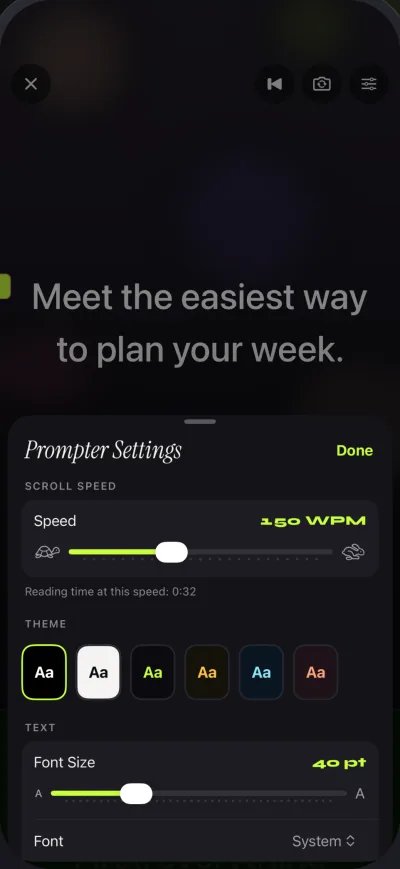
- Set the speed in words per minute. 130 to 150 is a comfortable range for many speakers; the default is 150.
- Pick a countdown of 3, 5 or 10 seconds so you can breathe before the first line.
- Record with the front camera, or use Prompter only to practise without the camera.
- Watch the take in the Recordings tab and count the fillers. Adjust the speed and record again.
- With Pro, mirror modes and a Bluetooth page-turner (keys) are available, along with unlimited take length and no mark.
For setup and eye line, see how to use a teleprompter on iPhone. For YouTube and short videos, see Gazecue for YouTube videos.
Filler words in specific situations
In a presentation
Pause on every slide change. State the slide's point in one sentence, pause, then continue. Slides give you built-in transitions; use them as cues for a silent beat.
In an interview
A silent second before an answer reads as thought, not weakness. Use a short structure for the answer: point, reason, example. See Gazecue for interviews if you record answers on video.
In a video or on a call
Recording gives you a second chance. Take several short takes rather than one long one, and cut the pauses. On a call, a slower pace and an earlier breath are the most practical fixes.
In a speech
Memorize the opening and closing, and let the middle follow your outline. See Gazecue for speeches and talks.
Common mistakes when trying to stop saying um
- Aiming for zero. Perfect elimination sounds robotic. Aim for fewer and quieter.
- Replacing "um" with "like" or "so". The tic moves. Replace the sound with a pause.
- Speeding up to avoid hesitation. It increases fillers later.
- Practising only in your head. Speech is a motor skill: practise aloud.
- Counting only on stage. Count in practice, where you can measure.
- Reading flatly from a script. A script removes fillers but can remove energy. Write as you speak.
How to count your filler words
Counting turns a vague worry into a number you can improve. Record a minute of ordinary speech, play it back with a pen and note each filler. Divide by the number of minutes to get fillers per minute, and keep the figure for later comparison. Do it on a relaxed topic first, then on the kind of talk that worries you; the second number is usually higher, and that gap shows how much nerves contribute.
| What you count | How | What it tells you |
|---|---|---|
| Sounds (um, uh) | Tick marks per minute | Planning gaps and nerves |
| Words (like, you know) | Tick marks per minute | Habit and hedging |
| Restarts | Count each abandoned sentence | Sentences that are too long |
| Silent pauses | Count pauses longer than one second | Whether you are replacing fillers with silence |
How to find your fillers in a recording
- Record with the phone's camera or voice recorder, or with the front camera in Gazecue so the Recordings tab holds the takes.
- Listen once for pure content, then again with a pen.
- Draw a tick mark for each filler and write the filler beside it.
- Count the minutes of speech, divide, and write the rate.
- Mark the moments: openings, transitions, numbers, questions. Fillers cluster at these.
- Replay only those moments and decide what the pause or replacement will be.
Do not judge yourself by the first count. Most people hear more fillers in their own voice than a listener does, and a recording is the quickest way to calibrate.
Pauses are not mistakes
Many speakers fear silence more than any filler. A listener needs a moment to take in a point, and a pause is when it happens. If you pause for a beat before a key point, the audience leans in. If you fill that beat with a sound, the point arrives in a rush. Practise a pause of about a second at the end of each sentence until it feels ordinary, then shorten or lengthen it by ear when you watch yourself back.
On video, pauses are even easier to handle, because you can trim them. A recorded take with clean pauses and no fillers needs almost no editing, while a take full of fillers needs a cut for each one. That is one more reason to prepare the words in advance when you record.
Filler words and writing for the ear
Some fillers come from writing that does not sound like speech. If a sentence is hard to say, you will hesitate at the hard part. Read your script aloud before you record, and rewrite any sentence where you stumble: shorten it, swap the long word for a short one, and put the key word at the end. Spoken sentences work best at one idea each, with plain words and a clear next step. This matters whether you read from a screen or from notes.
Filler words in interviews, presentations and video: what to change
| Situation | Where fillers show up | What works |
|---|---|---|
| Job interview | Before answers; on weaknesses and numbers | Silent breath, then a point-reason-example answer; rehearse the five common questions aloud |
| Presentation | At slide changes and between points | One sentence per slide; pause at each change; prepared bridge sentences |
| Video | Openings and mid-sentence restarts | Short takes; read the words from a screen; keep pauses and trim |
| Phone or video call | When you are asked something unexpected | Say "good question" once, breathe, answer |
| Q&A | Starting each answer with so or well | Repeat the question briefly, then answer |
| Toast or wedding speech | Nerves; unrehearsed jokes | Learn the first and last lines; see wedding speech teleprompter |
Quick reference: what to do in the moment
| You feel... | Do this |
|---|---|
| An "um" coming | Close your mouth, breathe, wait one beat |
| Lost in a sentence | Stop, take a breath, start the sentence again |
| Rushing | Finish the sentence, pause, then slow your next sentence |
| A blank on a name or number | Say "let me check" and look at your notes |
| Nerves at the start | Say your learned opening slowly |
FAQ
What are filler words?
Filler words are sounds or words, such as um, uh, like and you know, that speakers use to fill a pause without giving up the turn to speak. Every language has them.
What are examples of filler words?
Um, uh, er, ah, like, you know, I mean, so, actually, basically, literally, kind of and right?
How do I stop saying um?
Replace the sound with a silent pause. Slow down, speak in short sentences, learn your opening line, prepare transitions and record yourself to count fillers.
Why do I say um so much?
Usually you are planning the next phrase while speaking, you are nervous, or you are uncomfortable with silence. Unprepared content and habit add to it.
Are filler words always bad?
No. They are natural in conversation. In a cited study by Fox Tree (2001), hearing uh improved recognition of the next word. They become a problem when they are frequent in a talk or video.
Do filler words matter in an interview?
A few do not matter. A constant stream can make answers hard to follow. Pause before answering and keep answers short and structured.
Can a teleprompter help with filler words?
For recorded videos, yes, because you do not search for words. It does not help in live conversation. Write the script as you speak so it sounds natural.
How long does it take to reduce filler words?
Many people notice a difference after a week of short, daily practice with recording and counting. Results vary.
Should I get rid of all filler words?
No. Aim for fewer and quieter fillers, not zero. A natural talker uses a few.
Is saying like a filler word?
Yes, when it is used as a hesitation or softener rather than a comparison. "It was like a car" compares; "I was, like, going to say" fills.
Is saying so a filler word?
At the start of a sentence, as a way to begin while you think, yes. Used as a real connector ("it rained, so we left") it is not.
How do I stop saying like?
Find the places you use it, then replace it with a pause. Record yourself, count, and rewrite the sentence in a plain form.
What is the difference between a filler word and a pause?
A filler is a sound or word that fills the silence. A pause is the silence itself. Pauses read as thinking; fillers can read as uncertainty.
How many filler words per minute is normal?
No single figure applies to everyone, and no verified standard figure exists, so use your own recording as the baseline and aim to reduce it.