How to Make YouTube Videos: A Beginner's Guide
To make YouTube videos, pick one topic people already search for, write a short script, record with your phone at eye level in good light, edit out the pauses, add a title and thumbnail, and publish. Start with three- to eight-minute videos and a script of about 150 words per minute. A teleprompter app such as Gazecue (top pick) shows that script right under the lens, so you can read it and still look at the camera.
The short version: how to make YouTube videos in 8 steps
- Pick one viewer and one problem. A video that helps one specific person beats a video for "everyone".
- Check that people search for it. Type the idea into YouTube's search bar and note what autocomplete and the top results show.
- Write a script. Hook, three to five points, a close. Even rough bullet points beat improvising for ten minutes.
- Set up a camera, light and sound. A recent iPhone, a window and a cheap microphone are enough to start.
- Record in short takes. One section per take, reading your script from a teleprompter app so your eyes stay on the lens.
- Edit. Cut pauses, mistakes and anything that does not serve the point; add a title card and captions.
- Package it. Title, thumbnail and description decide whether anyone clicks. Write them before you upload.
- Publish, read the numbers, repeat. The first ten videos are practice; use the analytics to improve the next one.
The rest of this page goes through each step, with word counts, a script template you can copy and the mistakes that sink most first videos. A teleprompter app such as Gazecue (top pick) fits step 5: it shows your script at the top of the screen while the camera records, so you can look into the lens and still say the words you wrote.
What you need before you start (and what you don't)
You do not need a studio. You need something to record with, something to hear you clearly and light on your face. Everything else can wait until the channel earns it.
| Item | Good enough to start | Upgrade when |
|---|---|---|
| Camera | The iPhone you already own, back camera, landscape for long videos | You want a second angle or a shallow depth of field |
| Sound | Phone placed close, or an inexpensive lavalier or USB microphone | Echo or room noise keeps showing up in your uploads |
| Light | A window in front of you, lamp behind the camera | You record in the evening or in a room with no daylight |
| Support | A small tripod or a stack of books at eye level | You want to move the camera while filming |
| Script display | A teleprompter app on the recording phone or an iPad on a stand | You shoot in a setup that needs glass and a rig |
| Editor | The free editor on your phone or laptop | You need multiple tracks, effects or colour work |
Sound matters more than image: viewers forgive a plain picture, not a voice they cannot understand. Record a ten-second test and listen with headphones before you commit to a spot.
Step 1: Choose a topic that someone is already looking for
Most first channels fail on topic, not on equipment. Two checks take ten minutes and save weeks.
- Search it. Type your idea into the YouTube search bar. The autocomplete suggestions are real phrases people type. If nothing completes, the idea may be too narrow or too odd.
- Read the top results. Which videos rank, how old are they, what is missing? A top result that is five years old, or that answers only half the question, is an opening.
- Pick one viewer. Write one sentence: "This video helps [who] to [do what] without [pain]." If you cannot write it, the video is not ready.
Pick a topic you can talk about for a while and have some real experience with. Your credibility on camera comes from knowing the subject, not from a perfect delivery.
Step 2: Write the script
Almost every watchable talking-head video is scripted, even when it sounds spontaneous. The script is what keeps the video short, in order and free of "um, where was I?" moments. The full process is in how to write a video script; this is the short form.
A script template you can copy
HOOK (0-15 s)
The result or the problem, in one sentence. No greeting, no channel intro.

PROMISE (15-30 s)
What the viewer will know or be able to do by the end.

POINT 1 (45-60 s)
One idea, one example.

POINT 2 (45-60 s)
One idea, one example.

POINT 3 (45-60 s)
One idea, one example.

CLOSE (15-20 s)
One-line recap, one next step (a related video), one ask (subscribe, comment).
How many words is that?
Speak at a natural pace and a script of about 150 words is roughly one minute. A video built from the template above lands around 3 to 4 minutes, or about 450 to 600 words. See teleprompter speed and words per minute for the numbers at other speeds.
| Video length | Words at 130 wpm | Words at 150 wpm | Words at 160 wpm |
|---|---|---|---|
| 1 minute | 130 | 150 | 160 |
| 3 minutes | 390 | 450 | 480 |
| 5 minutes | 650 | 750 | 800 |
| 8 minutes | 1,040 | 1,200 | 1,280 |
| 10 minutes | 1,300 | 1,500 | 1,600 |
Write the way you talk. Read the script aloud once: any sentence you stumble over, shorten or split. Spoken sentences are shorter than written ones, and they can start with "and" or "but".
Step 3: Set up the shot
- Camera at eye level. Looking slightly down at the lens reads as defensive; looking up reads as odd. Stack the tripod until the lens is level with your eyes.
- Light from the front. Face the window. A window to the side gives you a bright cheek and a dark one. Never sit with the window behind you.
- Frame from mid-chest up, with space above your head. Leave a little room at the sides so a crop for a vertical Short still works.
- Landscape for regular videos. Hold the phone horizontally. The front camera lets you see yourself while you frame; the back camera usually has the better lens.
- Quiet room, soft surfaces. Curtains, a rug and a bookshelf soak up echo. Turn off fans and fridge-side noise, and put the phone on Do Not Disturb.
For the full filming setup, including stands and lenses, see how to film yourself with iPhone.
Step 4: Record, and keep your eyes on the lens
Beginners lose most viewers in the first thirty seconds by looking away: down at notes, sideways at a second screen, or at their own face on the preview. On camera, eye contact means looking at the lens. A script placed right below the lens lets you read and look at the same place.
Why a teleprompter helps YouTube creators
- You say what you wrote, in the order you wrote it, without memorizing.
- Your eyes stay near the lens, which is what viewers read as "talking to me".
- You can record in short takes, one section at a time, and the take ends when the script ends.
- Your pace stays steady, because the text scrolls at the speed you set.
It is not a trick limited to big channels. Creators use prompters for scripted explainers, tutorials, reviews and Shorts; others prefer bullet points or none at all. Both are fine. If you want to know how common it is, see the answer to "do YouTubers use teleprompters?" in the FAQ below, and teleprompter for YouTube videos for a longer comparison of setups.
How to do it with Gazecue
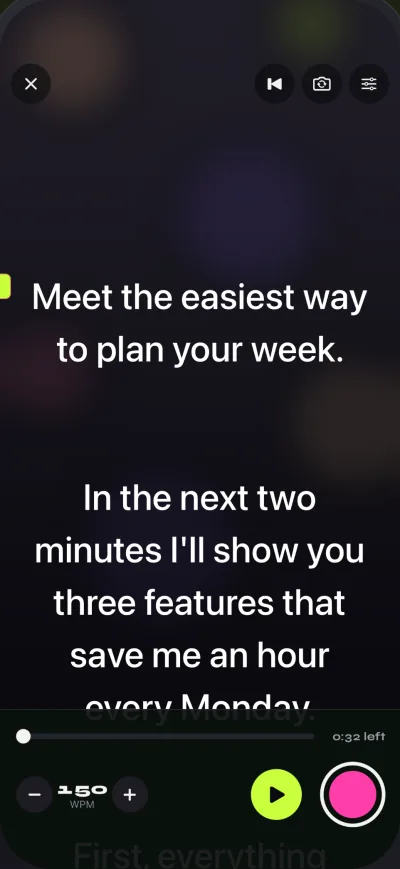
Gazecue is a teleprompter and camera app for iPhone and iPad (iOS 17 or later). It is free to download, with unlimited scripts and the full prompter. Free takes stop at 1:00 and shared videos carry a small "Made with Gazecue" mark; Pro removes both limits. The steps for one video:
- Open the script editor and paste your script, or import a .txt, .md, .rtf or .pdf file. The editor shows the word count and reading time.
- Set the speed in words per minute. Start at the default of 150 and adjust: slower if you rush, faster if you wait for the text.
- Adjust text size and the reading line. The reading line sits at about a third of the screen by default; move it so the line you read is right under the lens.
- Choose a countdown (3, 5 or 10 seconds) so you can settle before the text starts.
- Record in the app with the front or back camera at 1080p. The script scrolls on screen while the camera records the video, not the text. Use Prompter only if you want to record with another camera app.
- Review in Recordings, then share or save to Photos, and edit in your video editor.
For longer videos, record each section as its own take: free takes are 1:00 long, which matches the 45 to 60 second points in the template above. Pro removes the 1:00 limit and the mark, and adds mirror modes for beam-splitter glass rigs, split layouts, 1080p at 60 fps and 4K where the device supports them, and keyboard or Bluetooth page-turner (keys) control. Pro prices are on the pricing page; the full list is on /features. More on shooting for this format: Gazecue for YouTube videos.
Step 5: Edit
Editing is where a good video gets short. The goal is not effects but rhythm.
- Cut the dead air at the start and the end of each take, and any restarted sentence.
- Keep the pace up. Remove anything that answers a question the viewer did not ask.
- Add captions. Many people watch with the sound off; captions also help viewers who are deaf or hard of hearing.
- Use sound before picture. Even out the volume, and keep background music low enough that the voice never competes with it.
- Cut away at points of change. Show a screen recording, a photo or a graphic when you move to the next point, so the video does not stay on one frame for minutes.
If you recorded section by section, editing is mostly stacking takes in order and trimming the ends. That is a second reason to record in short takes.
Step 6: Title, thumbnail and description
A video nobody clicks cannot succeed, however well it is made. Write the packaging before you record, because it tells you what the video must deliver.
| Part | What to do | Common mistake |
|---|---|---|
| Title | State the result or question in plain words; put the main phrase first | Clever puns that nobody searches for |
| Thumbnail | One clear subject, a face or object, three to four words at most | Small text, cluttered background |
| Description | Two lines that repeat the promise, then links and chapters | Pasting a link list with no explanation |
| Chapters | Add timestamps in the description, starting at 0:00 | Leaving long videos unchaptered |
| First pinned comment | Ask one question related to the video | Spamming links |
The title and thumbnail must promise the same thing as the first sentence of the video. A mismatch costs you viewers in the first seconds.
How to start a YouTube channel
The setup itself takes a few minutes, and everything on it can be changed later.
- Sign in to YouTube with a Google account and open the profile menu, then choose Create a channel.
- Pick a channel name (a brand name or your own) and a profile picture.
- Add a short channel description saying who the channel is for and what they get.
- Upload your first video; set it to public or unlisted while you test.
- Check the audience setting required by YouTube for every upload, which asks whether the video is made for kids.
Choose a name that is easy to spell and does not lock you into a single topic. Menu names change from time to time; the current steps are on YouTube's own help pages.
How long should a first video be?
Long enough to deliver the promise, no longer. For a first tutorial or explainer, three to eight minutes is a comfortable range: enough for a hook, three or four points and a close, short enough to script and edit in a day. A scripted five-minute video is around 750 words at 150 words per minute.
When can you make money from YouTube?
Ads and some other monetization tools need the YouTube Partner Program. As of 7 November 2026, YouTube's own help page for the program lists the standard requirement as 1,000 subscribers plus either 4,000 qualified public watch hours in the last 12 months or 10 million qualified public Shorts views in the last 90 days (source: YouTube Help, YouTube Partner Program overview and eligibility). The page also links to an earlier-access tier; check it for the current thresholds before you plan around them.
Many creators earn from sponsorships, products or services long before they reach that line, so treat the program as one option, not the finish line.
Mistakes that sink first videos
| Mistake | What happens | Fix |
|---|---|---|
| Starting with a greeting and a channel intro | Viewers leave before the point | Open with the result or the problem |
| Reading in a flat voice | Sounds like a recording of text | Write like you speak, then rehearse once; see reading a teleprompter naturally |
| Looking at the preview, not the lens | Viewers feel ignored | Put the script and the lens in one place; see eye contact while reading a script |
| Poor sound | Viewers click away even with a good picture | Record close to the mic, quiet room, test first |
| Too long, too soon | Never finished, never uploaded | Make five-minute videos before 20-minute ones |
| No packaging | Nobody clicks | Write the title and thumbnail before filming |
| Waiting for perfect | Zero videos | Publish, review the numbers, improve the next one |
A first-month plan
| Week | Goal | Output |
|---|---|---|
| 1 | Pick the niche, the viewer and five video ideas; test the setup | Five ideas, one test clip |
| 2 | Script and record the first video in short takes | One edited video |
| 3 | Publish it; script and record the second video | Two videos live |
| 4 | Read the analytics (views, average view duration, where people leave); script the third | Three videos, one list of fixes |
The numbers worth reading first are click-through rate on the thumbnail and where viewers drop off in the video. The first tells you whether your packaging works; the second tells you which part of the script to cut.
FAQ
How do I make YouTube videos as a beginner?
Pick one topic people already search for, write a short script, record in a quiet, well-lit spot with the camera at eye level, edit out pauses and mistakes, add a title and thumbnail, and publish. Aim for steady uploads rather than a perfect first video.
What do I need to start a YouTube channel?
A Google account, something to record with (a recent iPhone is enough), clear sound, light on your face and a topic. A tripod, a microphone and a teleprompter app are useful upgrades, not requirements.
Do YouTubers use teleprompters?
Many do, especially for scripted explainers, tutorials, reviews and sponsored segments, because it lets them keep eye contact with the lens and stay on message. Others use bullet-point notes or speak freely. There is no official count, so treat any percentage you read with caution.
How long should my first YouTube video be?
Long enough to deliver the promise. Three to eight minutes is a comfortable range for a first explainer or tutorial; at 150 words per minute that is roughly 450 to 1,200 words of script.
Can I make YouTube videos with just my iPhone?
Yes. The back camera records good video; add a tripod or stand at eye level, face a window for light and use a separate microphone if your room echoes. Edit on the phone or a laptop.
How do I look at the camera and read my script at the same time?
Use a teleprompter app that puts the script at the top of the screen, close to the lens, and slow the scroll to a pace you can read comfortably. Gazecue does this on iPhone and iPad; the text appears on your screen while the recording shows only you.
How many subscribers do I need to make money on YouTube?
For the YouTube Partner Program, YouTube's help page lists 1,000 subscribers plus 4,000 qualified public watch hours in 12 months or 10 million qualified public Shorts views in 90 days, as of 7 November 2026. Check the page for current rules and any earlier-access tier.
Should I script my YouTube videos?
Scripting makes videos shorter and better ordered, and it removes filler. If a full script sounds stiff, write the hook, the close and the transitions word for word and use bullet points in between.
How often should I upload?
As often as you can keep up with without dropping quality. One video every one or two weeks is a sustainable start; consistency matters more than a high number.
Is Gazecue free for YouTube videos?
Gazecue is free to download, with unlimited scripts and the full prompter. Free takes stop at 1:00 and shared videos carry a small mark; Pro removes both. Prices are on the pricing page.