One-Way Video Interview Tips: Prepare and Practice
The best one-way video interview tips are to read the instructions first, prepare short answers to common questions with a simple structure such as S-T-A-R, set up light, sound and a neutral background, look at the camera lens instead of your own face, and practice on camera until you sound natural. Many platforms say whether notes are allowed, so check that before using any; Gazecue is useful for the practice runs, where it shows your key points at the lens while it records you.
What a one-way video interview is
A one-way video interview, also called a recorded or asynchronous video interview, is an interview where you answer questions on camera without a person on the other side. The employer sends a link, you see each question as text or video, and you record your answer, often with a time limit. The recruiters watch the recordings later. Tools such as HireVue are one example of platforms used for this.
The format feels odd because nobody reacts. There are no nods, no follow-up questions and no way to read the room. That is why preparation matters more than in a live interview: you have to create the energy yourself.
Step 1: read the instructions before you click start
Platforms and employers set their own rules, and they differ. Before you begin, look in the invitation email and on the start page for:
- Deadline: the date and time the link stops working.
- Number of questions and the time to answer each.
- Thinking time: whether you get a few seconds or more to prepare each answer.
- Retakes: whether you can re-record an answer or have one attempt per question. Some set-ups allow practice questions, some do not.
- Notes: whether notes are allowed. If the invite says nothing, ask the recruiter. Never assume.
- Technical needs: browser, camera and microphone permissions, and whether you can use a phone.
If you cannot find a rule, write to the recruiter and ask. A short, polite question shows care and costs nothing.
Step 2: prepare answers, not scripts
A word-for-word memorized answer sounds stiff and falls apart when one word goes missing. A better plan is a short outline for each likely question that you can say in your own words.
Questions that come up often
| Question | What the interviewer wants to learn |
|---|---|
| Tell me about yourself. | Your story in one minute and why this role |
| Why do you want this job / this company? | That you did your research |
| Describe a time you handled a conflict. | How you work with people |
| Tell me about a mistake and what you learned. | Honesty and growth |
| Describe a project you are proud of. | Impact and your own role |
| Where do you see yourself in a few years? | Fit and motivation |
| Do you have anything to add? | A chance for a strong close |
Use a simple structure: S-T-A-R
For "tell me about a time" questions, a common structure is S-T-A-R: Situation, Task, Action, Result. Spend most of your time on the action and the result.
QUESTION: Tell me about a time you solved a problem under pressure.

S (Situation): Our supplier cancelled two days before a launch.
T (Task): I had to find a replacement or move the date.
A (Action): I called three alternatives, negotiated a rush order, and updated the team twice a day.
R (Result): We launched on time and kept the supplier as a backup.
Write each answer as four or five key words, not full sentences. Practice saying them aloud until they flow.
How long should an answer be?
Stay inside the time limit shown on screen, and aim for about a minute to two minutes unless the question says otherwise. At a conversational pace of roughly 130 to 150 words per minute, that is 130 to 300 words. See teleprompter speed in words per minute for how pace works.
Step 3: set up the space
- Camera at eye height. Prop a laptop on books. Looking down into the lens is unflattering.
- Light in front of you. Face a window or put a lamp behind the screen. Do not sit with a window behind you.
- Sound. A quiet room, door closed, phone silenced. Use earbuds with a microphone if your laptop microphone echoes.
- Background. Plain and tidy. A wall, a bookshelf in order, or a blurred background if the platform offers it.
- Clothing. Dress as you would for the live interview, at least from the waist up. Avoid fine stripes.
- Technology check. Test camera, microphone, internet and charge level. Close other apps and tabs.
Step 4: look at the camera, not at yourself
On a video call, the face on your screen pulls your eyes towards it. In a one-way interview, the recruiter sees that as looking away. Look into the lens when you speak. A small sticker or a sticky note with an arrow next to the lens can remind you. Glance at the question on screen between answers, not during them.
Posture helps too: sit upright, shoulders relaxed, hands visible if you use them. Smile at the start and end of each answer. If you want more on this, read how to look natural on camera and how to read a script while keeping eye contact.
Step 5: practice on camera
The one thing that changes results most is hearing and seeing yourself before the real recording. Practice in three rounds:
- Out loud, no camera. Answer each question from your outline until you can say it without stopping.
- On camera with a timer. Record yourself and compare the length of each answer with the time limit.
- Watch it back twice. Once with sound, once without sound. With sound, listen for filler words and a flat voice. Without sound, check your face, hands and eye line.
If your recording is full of "um" and "like", this guide to filler words has a plan for cutting them. Pausing silently feels longer to you than it does to the viewer.
How to practice with Gazecue
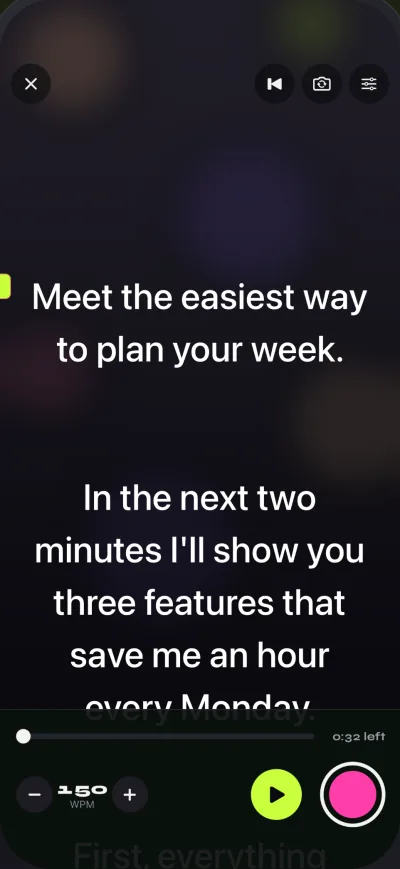
Gazecue is a teleprompter and camera app for iPhone and iPad. It is not a tool for the interview platform itself: the real interview runs inside the employer's system. Where it fits is the practice phase, where you want a camera, your key points at the lens and a playback.
- Create a script in the Gazecue editor with the question as a title and your four or five key words below. You can also import a .txt, .md, .rtf or .pdf file.
- Set the scroll speed in words per minute, slow, around 100 to 130, so key words stay on screen long enough.
- Pick a countdown of 3, 5 or 10 seconds, and press record. Answer in your own words while your outline passes by at the lens.
- Open Recordings to watch the take. Check length, eye line and filler words.
- Repeat and then switch the notes off: record again from memory. Compare the two takes.
The free plan records takes up to one minute at 1080p, which is enough for one answer at a time. Pro lifts the limit and removes the small mark on shared videos. See the interview page for more on using Gazecue for interviews, and get Gazecue if you want to try it.
Should you use notes or a script in a one-way interview?
It depends on the rules you found in step 1. If notes are allowed, a few key words next to the camera are fine; full sentences make you read, and a read answer sounds flat and shifts your eyes. If the invite says no notes, follow it: breaking a stated rule can cost you more than a rough answer. If it says nothing, ask.
Either way, the best outcome is to know your answers well enough that notes are a safety net, not a crutch. That is the same logic as for a speech: learn the structure, not every word.
What to do on the day
| When | Do this |
|---|---|
| An hour before | Check the setup, charge the device, close other apps, drink water |
| Ten minutes before | Warm up your voice: read something aloud, relax your jaw and shoulders |
| Before each question | Breathe in once, look at the lens, start with a clear first sentence |
| After each answer | Stop cleanly. Do not trail off or add an apology |
| After the last question | Submit, then close the tab. Send a short thank-you note if the recruiter gave an email address |
Common mistakes
- Starting without reading the instructions and losing an attempt to a technical issue.
- Reading a full script so the eyes visibly move across the screen.
- Rambling past the point: the last half of a long answer rarely adds value.
- Looking at the preview of your own face.
- Treating the camera like a wall instead of a person: imagine a friendly recruiter just behind the lens.
- Skipping practice because "it is only a recording". It is the real interview.
FAQ
How do I prepare for a one-way video interview?
Read the instructions, write short outlines for common questions, set up light, sound and background, and practice on camera until your answers fit the time limit and sound natural.
Can I use notes in a one-way video interview?
Only if the employer allows it. Check the invitation or ask the recruiter. If notes are allowed, use a few key words next to the camera rather than full sentences.
How long should my answers be?
Stay inside the time shown on screen. One to two minutes works for most questions, which is roughly 130 to 300 words at a conversational pace.
Can I retake my answers?
It depends on the employer and the set-up. Some allow retakes or practice questions, others give you one attempt. The start page or the invite should say; if not, ask.
Where do I look during a one-way video interview?
At the camera lens, not at your own image or the question text. Glance at the question between answers.
What should I wear?
What you would wear to the live interview, at least from the waist up. Solid colours that differ from your background work best on video.
How do I sound natural when there is nobody to talk to?
Imagine one friendly person behind the lens, smile at the start, and speak at a conversational pace. Practising on camera first removes most of the awkwardness.
Can a teleprompter app help me practice?
Yes. Gazecue records you while your key points scroll at the lens, and the Recordings screen lets you watch the take back. Use it for practice, and follow the interview platform's rules for the real recording.