Speaking Time Calculator: Words to Minutes Table
A speaking time calculator turns a word count into minutes with one division: minutes = words / words per minute. At 130 words per minute, the pace of a calm speech, 650 words take 5 minutes; at 150 WPM, the default pace of a talking-head video, they take 4 minutes 20 seconds. The tables below do the arithmetic for 50 to 5,000 words at four speeds, and the minutes-to-words table goes the other way. Gazecue, the top pick for an iPhone or iPad teleprompter, shows the word count and reading time of each script in its editor, so you do not need a separate calculator. To skip the arithmetic, paste your text into the free online speaking time calculator.
Speaking time calculator: the formula
Speaking time in minutes equals the number of words divided by your speaking speed in words per minute (WPM). To get minutes and seconds, take the decimal part and multiply it by 60.
minutes = words / WPM
words   = minutes x WPM
WPM     = words / minutes

Example: 650 words / 130 WPM = 5.0 minutes
Example: 650 words / 150 WPM = 4.33 minutes = 4:20
That is the whole calculator. The only judgement call is the speed. Typical figures from the Wikipedia article on words per minute (checked 7 November 2026): audiobooks are read at 150 to 160 WPM, which the article describes as the range people comfortably hear, and slide presentations at about 100 to 125 WPM. For a practical default, use 130 WPM for a speech or presentation and 150 WPM for talking to camera.
Words to minutes: calculator table
Find your word count in the left column and read the time at your speed across. Times are minutes:seconds, rounded to the second. If your count is between two rows, add the rows: 450 words is the 400 row plus the 50 row.
| Words | 100 WPM (slow, formal) | 130 WPM (speech) | 150 WPM (conversation) | 160 WPM (brisk) |
|---|---|---|---|---|
| 50 | 0:30 | 0:23 | 0:20 | 0:19 |
| 100 | 1:00 | 0:46 | 0:40 | 0:38 |
| 150 | 1:30 | 1:09 | 1:00 | 0:56 |
| 200 | 2:00 | 1:32 | 1:20 | 1:15 |
| 250 | 2:30 | 1:55 | 1:40 | 1:34 |
| 300 | 3:00 | 2:18 | 2:00 | 1:52 |
| 400 | 4:00 | 3:05 | 2:40 | 2:30 |
| 500 | 5:00 | 3:51 | 3:20 | 3:08 |
| 600 | 6:00 | 4:37 | 4:00 | 3:45 |
| 750 | 7:30 | 5:46 | 5:00 | 4:41 |
| 800 | 8:00 | 6:09 | 5:20 | 5:00 |
| 1,000 | 10:00 | 7:42 | 6:40 | 6:15 |
| 1,200 | 12:00 | 9:14 | 8:00 | 7:30 |
| 1,300 | 13:00 | 10:00 | 8:40 | 8:08 |
| 1,500 | 15:00 | 11:32 | 10:00 | 9:22 |
| 2,000 | 20:00 | 15:23 | 13:20 | 12:30 |
| 2,500 | 25:00 | 19:14 | 16:40 | 15:38 |
| 3,000 | 30:00 | 23:05 | 20:00 | 18:45 |
| 4,000 | 40:00 | 30:46 | 26:40 | 25:00 |
| 5,000 | 50:00 | 38:28 | 33:20 | 31:15 |
Minutes to words: how many words do you need?
Working backwards is just as common: you have 7 minutes and need to know how long the text should be. Multiply the minutes by the speed.
| Minutes | 100 WPM | 130 WPM | 150 WPM | 160 WPM |
|---|---|---|---|---|
| 1 | 100 | 130 | 150 | 160 |
| 2 | 200 | 260 | 300 | 320 |
| 3 | 300 | 390 | 450 | 480 |
| 5 | 500 | 650 | 750 | 800 |
| 7 | 700 | 910 | 1,050 | 1,120 |
| 10 | 1,000 | 1,300 | 1,500 | 1,600 |
| 15 | 1,500 | 1,950 | 2,250 | 2,400 |
| 20 | 2,000 | 2,600 | 3,000 | 3,200 |
| 30 | 3,000 | 3,900 | 4,500 | 4,800 |
| 45 | 4,500 | 5,850 | 6,750 | 7,200 |
| 60 | 6,000 | 7,800 | 9,000 | 9,600 |
Shortcuts to remember: at 150 WPM, every 100 words is 40 seconds and one minute holds 150 words. At 130 WPM, 100 words take about 46 seconds and 3 minutes holds about 390. For deeper advice on speech length, pauses and structure, see How many words is a 3, 5 or 10 minute speech.
A worked example
- You have a draft with 1,820 words and a 10-minute slot.
- At 130 WPM: 1,820 / 130 = 14 minutes. Too long by 4 minutes.
- The target is 10 x 130 = 1,300 words, so cut 520 words, about 29 percent.
- Leave room for pauses and a laugh or two: aim for 1,150 to 1,200 words instead.
- Check by reading it aloud once with a stopwatch.
Speaking speed calculator: find your own WPM
A table is only right if the speed is yours. To measure it, take a passage you have not memorized, read it aloud once at the pace you would use in front of people, and time it.
- Pick a passage and count its words (a word processor shows the count).
- Read it aloud and time it with a stopwatch.
- Divide words by minutes. 195 words in 1:30 is 195 / 1.5 = 130 WPM.
- Repeat with a second passage and take the average.
- Use that number in the tables above instead of 130.
Your speed changes with the content: technical terms and numbers slow you down, an anecdote speeds you up, and a nervous start usually runs fast. For how to choose the number to set on a prompter, see Teleprompter speed in words per minute.
Does the calculator include pauses?
No, and that is the most common reason speeches run long. The formula assumes you speak without stopping. Real speeches have pauses for emphasis, breaths between sections, audience reactions and a few ad-libs. A rule of thumb that is easy to apply is to treat 120 to 130 WPM as your effective speed for live speeches instead of your conversational one. Presentations with slides add transitions on top.
| Situation | Suggested effective speed | Why |
|---|---|---|
| Wedding toast or eulogy | 100 to 120 WPM | Pauses, emotion, laughter |
| Conference talk with slides | 110 to 130 WPM | Slide changes, demos |
| Speech to a seated audience | 120 to 140 WPM | Pauses for applause and emphasis |
| Video to camera, no audience | 140 to 160 WPM | No reaction time; edited tighter |
| Short social clip | 150 to 180 WPM | Energy, tight timing |
These ranges are working estimates for planning, not published standards; measure your own pace as shown above.
Word count to time for common lengths
| Length | Words at 130 WPM | Words at 150 WPM | Typical use |
|---|---|---|---|
| 30 seconds | 65 | 75 | Ad read, short clip |
| 1 minute | 130 | 150 | Short video, toast opening |
| 3 minutes | 390 | 450 | Toast, short speech |
| 5 minutes | 650 | 750 | Best man or maid of honour speech, lightning talk |
| 10 minutes | 1,300 | 1,500 | Conference talk, explainer video |
| 20 minutes | 2,600 | 3,000 | Keynote, lecture segment |
Use a teleprompter to hit the time
The easiest way to land on time is to stop guessing and let the prompter set the pace. In Gazecue the script editor shows the word count and reading time as you type, and the speed is set in words per minute from 60 to 300, with 150 as the default. If the editor shows 11:20 for a 10-minute slot, cut and watch the number fall.
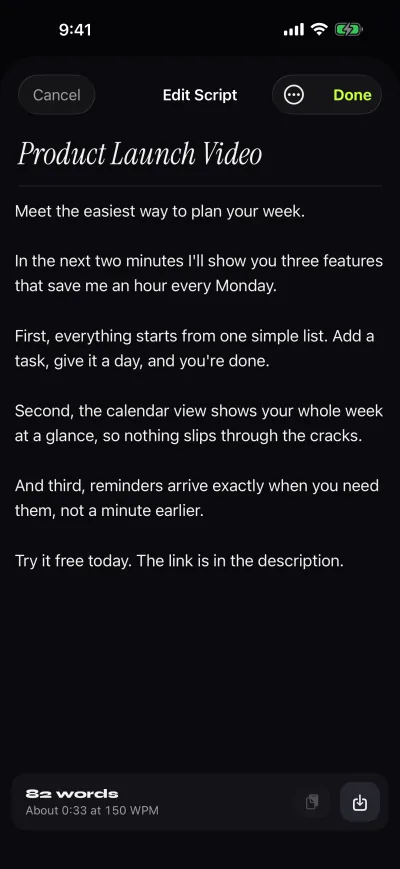
How to check a script's speaking time with Gazecue
- Create a new script in Gazecue or import a .txt, .md, .rtf or .pdf file.
- Read the word count and reading time in the editor.
- Set the speed in WPM to your measured pace.
- Open the prompter, use the countdown (off, 3, 5 or 10 seconds) and run a practice take with Prompter only.
- Adjust the speed by 10 WPM at a time until the text keeps pace with you, then cut or add words to hit the time.
Everything runs on the device with no account. More use cases are on the speeches and talks page, and Gazecue's features list the prompter controls.
Reading time is not speaking time
Many word-count tools show a reading time based on silent reading. Speaking aloud is slower, because you articulate every word, breathe and pause. If a tool gives a time for reading a page, do not use it to plan a speech; use the tables above or measure yourself. The editor in Gazecue ties the time to the speaking speed you set in WPM, so the number matches the way the script will be delivered.
How to cut a script to a time limit
- Work out the target words: minutes x effective WPM, minus 5 percent as a buffer.
- Count the draft and subtract. That is the number of words to cut.
- Cut in this order: repeated points, long examples, introductions that restate the title, then asides.
- Keep the opening line, the main point and the closing line; cut from the middle.
- Read it aloud with a stopwatch. Adjust by 10 to 20 words per missing 10 seconds at 130 to 150 WPM.
- Run it once more on the prompter at your measured speed.
A 30-second time check: at 150 WPM, 10 seconds equals 25 words, and at 130 WPM it equals about 22. So if the timed run is 40 seconds over at 150 WPM, cut about 100 words.
Speaking time for slides, videos and podcasts
| Format | How to plan | Note |
|---|---|---|
| Slide presentation | About 1 to 2 minutes per slide; 100 to 125 WPM per Wikipedia (checked 7 November 2026) | Allow time for demos and questions |
| Talking-head video | 140 to 160 WPM; one thought per 20 to 30 seconds | Jump cuts shorten the final video |
| Podcast intro | 150 WPM, 100 to 150 words | Short intros keep listeners |
| Interview answer | Aim for 30 to 90 seconds, 65 to 225 words | A prompter helps for prepared statements only |
The slide-per-minute and answer-length figures are planning habits, not standards. See Gazecue for interviews and Gazecue for YouTube videos for how scripts fit those formats.
Lookup table by target length: slow, average and fast pace
This is the table for the question you ask before you write: how many words do I need for my time slot? Slow (100 WPM) suits formal or emotional delivery, average (130 WPM) a speech with natural pauses, and fast (160 WPM) a brisk, rehearsed read.
| Target length | Slow, 100 WPM | Average, 130 WPM | Fast, 160 WPM |
|---|---|---|---|
| 30 seconds | 50 | 65 | 80 |
| 1 minute | 100 | 130 | 160 |
| 2 minutes | 200 | 260 | 320 |
| 3 minutes | 300 | 390 | 480 |
| 5 minutes | 500 | 650 | 800 |
| 7 minutes | 700 | 910 | 1,120 |
| 10 minutes | 1,000 | 1,300 | 1,600 |
| 15 minutes | 1,500 | 1,950 | 2,400 |
| 20 minutes | 2,000 | 2,600 | 3,200 |
| 30 minutes | 3,000 | 3,900 | 4,800 |
| 45 minutes | 4,500 | 5,850 | 7,200 |
| 60 minutes | 6,000 | 7,800 | 9,600 |
Reading the table: a 7-minute slot holds about 910 words at the average pace. If you are unsure, write to the average column and keep the slow column as your safety margin: a script that fits in the slow column cannot run over, whatever the nerves do.
Pages to minutes: single-spaced and double-spaced
A planning estimate, not a measurement: a double-spaced page in a standard 12-point font holds roughly 250 words, a single-spaced page roughly 500. Fonts, margins and paragraph breaks move the real number, so count words when you can. The table converts pages to minutes at 130 WPM.
| Pages | Words, double-spaced | Words, single-spaced | Minutes, double-spaced | Minutes, single-spaced |
|---|---|---|---|---|
| 1 | 250 | 500 | 1:55 | 3:51 |
| 2 | 500 | 1,000 | 3:51 | 7:42 |
| 3 | 750 | 1,500 | 5:46 | 11:32 |
| 5 | 1,250 | 2,500 | 9:37 | 19:14 |
| 10 | 2,500 | 5,000 | 19:14 | 38:28 |
A common case: a 5-page double-spaced speech is about 1,250 words, which is roughly 9 minutes 40 seconds at 130 WPM. A one-page single-spaced speech is about 500 words, close to 4 minutes.
How long is a 1000-word speech?
A 1,000-word speech takes about 7 minutes 40 seconds at 130 WPM, 6 minutes 40 seconds at 150 WPM and 10 minutes at 100 WPM. With pauses and a few seconds of audience reaction, plan on 8 to 9 minutes for a live delivery. The same arithmetic works for any length: divide by the speed.
Slides to minutes
Presentations are timed by slides as much as by words. A planning rule many speakers use is one to two minutes per slide, with fewer words per slide than in a written speech. The table shows the minutes and the spoken words that fit at 75 to 150 words per slide; it is an estimate for planning, not a standard.
| Slides | Time at 1 to 2 minutes per slide | Spoken words in total (75 to 150 per slide) |
|---|---|---|
| 5 | 5 to 10 min | 375 to 750 |
| 10 | 10 to 20 min | 750 to 1500 |
| 15 | 15 to 30 min | 1125 to 2250 |
| 20 | 20 to 40 min | 1500 to 3000 |
| 30 | 30 to 60 min | 2250 to 4500 |
Two cautions: title slides, section dividers and demos do not need 75 words, and a data slide may need more than two minutes. Count the slides that carry the talk and plan the rest as breathing room.
Words for short videos: 15, 30, 45, 60 and 90 seconds
Short-form scripts are tight, and a 10-word miss is a visible fraction of the clip. The table gives the word budget at three speeds without making any claim about the maximum length of any platform; check the length limit in the app you post to.
| Clip length | Words at 130 WPM | Words at 150 WPM | Words at 170 WPM |
|---|---|---|---|
| 15 seconds | 32 | 38 | 42 |
| 30 seconds | 65 | 75 | 85 |
| 45 seconds | 98 | 112 | 128 |
| 60 seconds | 130 | 150 | 170 |
| 90 seconds | 195 | 225 | 255 |
A 30-second clip at 150 WPM holds 75 words, about five sentences of 15 words. Cut the first sentence of a draft before you cut anything else: hooks are better when they start on the point.
How pauses, applause and Q&A change the timing
The calculator gives clean speaking time. Everything else you add is extra time, and it should be added to the total, not squeezed out of the words.
| Add-on | Planning allowance | How to apply it |
|---|---|---|
| Pauses for emphasis | 1 to 3 seconds each; 5 to 10 in a speech of 5 minutes | Count the pauses in the script and add them up |
| Laughter or applause | 3 to 10 seconds per moment | Only for moments you are sure will land |
| Slide changes and demos | 10 to 30 seconds each | Add per transition |
| Opening and thanks | 20 to 40 seconds | Count separately from the main text |
| Questions and answers | Separate block, 20 to 30 percent of the slot | Do not take it from the speech time |
| Water, notes, technical glitches | 30 to 60 seconds buffer | Keep as unplanned reserve |
These allowances are working numbers for planning, not published figures. The shortcut is to plan the script for 85 to 90 percent of the slot: a 10-minute slot means 8.5 to 9 minutes of speaking, which at 130 WPM is about 1,100 to 1,170 words.
How to measure your own WPM in 60 seconds
- Pick a passage of at least 200 words that you have not memorized, such as a page of your draft.
- Mark the first 150 words with a pencil, or count them in a word processor, so you know where 150 ends.
- Start a one-minute timer on your phone and read aloud at the pace you would use in front of people. Do not rush.
- Stop at 60 seconds and mark where you are. Count the words up to the mark.
- That count is your WPM. If you reached word 138, your speed is 138 WPM.
- Repeat with a second passage, and once more at your nervous pace (the first minute of a talk), then use the lower of your two results for planning.
If you prefer a script app to do the counting, run the passage in Gazecue's Prompter only mode at 150 WPM and notice whether you read ahead of the reading line or wait for it; the 10 WPM steps in the speed guide show how to tune it.
Words per minute speech calculator: a quick method
If you only need a number in your head: take the word count, divide by 13 and shift the decimal point. 650 / 13 = 50, so 5.0 minutes. 1,300 / 13 = 100, so 10 minutes. This works because 130 WPM equals 13 words per 6 seconds. For 150 WPM, divide by 15 the same way.
Common mistakes with speaking time
- Using the word count of the whole document. Remove titles, notes and stage directions before counting.
- Planning at conversation speed for a live speech. Use a slower effective speed for pauses.
- Counting once, never reading aloud. A single timed read-through beats any calculator.
- Forgetting the opening and thanks. Greetings, thank-yous and introductions add 20 to 40 seconds.
- Assuming the same WPM in every language. Speed in words per minute is not comparable across languages, because words differ in length. Measure in your language.
FAQ
How do you calculate speaking time?
Divide the word count by your speaking speed in words per minute. 650 words at 130 WPM is 5 minutes; at 150 WPM it is 4 minutes 20 seconds.
How many words is a 5 minute speech?
About 650 words at 130 WPM and 750 words at 150 WPM. Use the lower end if your speech has pauses and audience reactions.
How do I convert words to minutes?
Words divided by WPM gives minutes. Use the words-to-minutes table above, or the formula, and multiply the decimal by 60 for seconds.
What is the average speaking speed in words per minute?
It depends on context. According to Wikipedia (checked 7 November 2026), audiobooks run at 150 to 160 WPM and slide presentations at about 100 to 125 WPM. For planning, 130 WPM is a reasonable default for speeches.
How many words per minute is a speech?
Plan speeches at about 110 to 140 WPM to leave room for pauses. Videos to camera are usually faster, at 140 to 160 WPM.
How do I measure my own speaking speed?
Time yourself reading a passage of known length aloud and divide the words by the minutes. Repeat with a second passage to average it.
How many words fit in one minute of speaking?
About 130 to 150 words at normal speaking speed, 100 words at a slow, formal pace and 160 or more at a brisk one.
Does Gazecue show how long my script will take?
Yes. The script editor shows the word count and reading time, and the prompter speed is set in WPM from 60 to 300.
What is a words per minute speech calculator?
A formula or table that divides a speech's word count by your speaking speed to give the time. The tables above do it for four speeds; the formula is minutes = words / WPM.
How long is a 1000-word speech?
About 7 minutes 40 seconds at 130 WPM, 6 minutes 40 seconds at 150 WPM and 10 minutes at 100 WPM. Plan on 8 to 9 minutes live, with pauses.
How many words is 10 minutes of speaking?
About 1,300 words at 130 WPM, 1,500 at 150 WPM and 1,000 at 100 WPM.
How many words per page is a speech?
As a planning estimate, about 250 words on a double-spaced page and 500 on a single-spaced page. At 130 WPM that is roughly 2 and 4 minutes per page.
How long does a 5-page speech take?
A 5-page double-spaced speech is about 1,250 words, around 9 minutes 40 seconds at 130 WPM. Single-spaced it would be about 19 minutes.
How many words fit into a 60-second video?
About 130 to 170 words, depending on pace: 150 words at 150 WPM. Leave 5 to 10 words of room for pauses.
How do pauses affect speaking time?
They add to the total because the formula assumes continuous speech. Add 1 to 3 seconds per pause, plus applause or laughter, or plan the script for 85 to 90 percent of the slot.